
Before we take our Energy Quiz, lets see if you have what it takes to be called a Photosynthesis or Cellular Respiration Master! Click the links below, download the attached powerpoint, open in keynote and play the presentation. As you go through, click the appropriate boxes and answers to questions. If you can successfully get through the whole thing with no wrong answers, you are ready! Take as much time and as many tries as you need! Good luck!
Author Archives: mrkubuske
Cellular Respiration
Cellular Respiration, although the inputs and outputs seem easy, the process is very convoluted and complicated. Lucky for you, we’re going to simplify it to a point that is appropriate for a High School Biology student.
Keep in mind that Photosynthesis & Cellular Respiration are reciprocal reactions. What that means is that the requirements of Cellular Respiration are the products of Photosynthesis! Likewise, the products of Cellular Respiration are the requirements of Photosynthesis! Its a 3 Billion year long symbiotic relationship! (And you thought your month-long high school girlfriend was a long-term commitment!)
Here is the jist of what Aerobic (meaning with Oxygen present) Respiration entails…

Glycolysis
- Uses 2 ATP to break down Glucose
- NADH & 4ATP (net gain +2 ATP) are created.
- The NADH goes to the Krebs Cycle.
Krebs Cycle
- Uses Oxygen and Acetyl-CoA
- Makes 2 ATP, NADH, & FADH2 (both of which are electron carriers)
- Carbon Dioxide is given off as a byproduct.
- The NADH goes on to the ETC
Electron Transport Chain
- Uses Oxygen and NADH
- Make 32 ATP and Water (used as an electron acceptor)
Photosynthesis
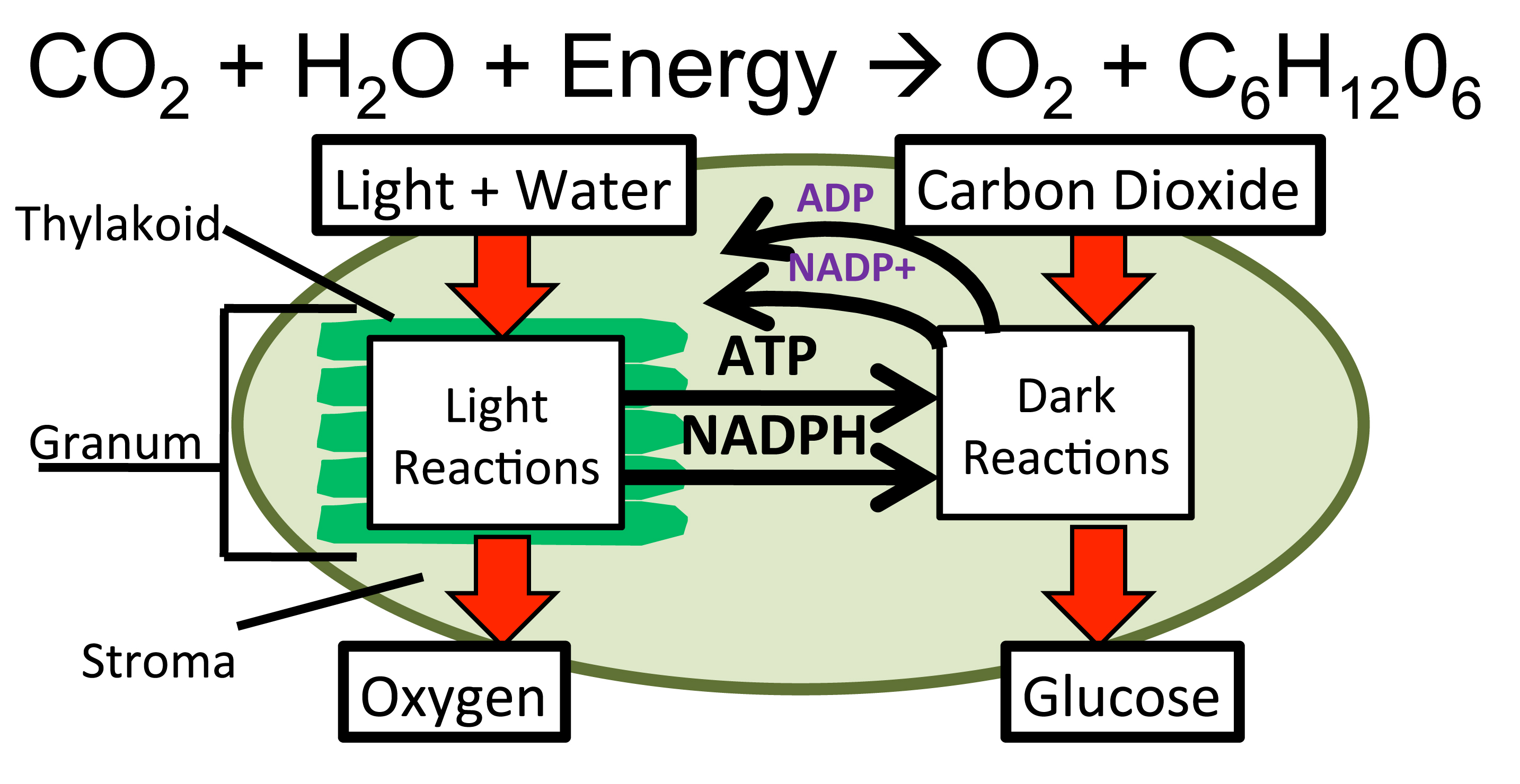
 Photosynthesis may seem like an easy topic, based on what you learned in middle school. But, as we go a little deeper into the processes of how Plants chemically create glucose from a gas, a liquid, and sunlight we find that it is a whole lot more interesting and complicated. Below is a graphic organizer to show the parts of the chloroplast, the reactants, the products, and the important molecules involved in both the Light & Dark Reactions.
Light Reaction
- Light & Water enter the Thylakoid (or granum)
- Oxygen is released as a byproduct
- In the process, NADPH and ATP are charged and carry energy to the Dark Reactions.
Dark Reactions
- The ATP and NADPH, combined with Carbon Dioxide, create Glucose.
- The leftover NADP+ and ADP go back to the light reaction.
Once you think you’ve Mastered all there is to know about Photosynthesis, try your hand at this game: Photosynthesis Master. Open the document in Powerpoint or Keynote, start the presentation, then click on the boxes with the correct answers to the questions. See if you can make it all the way through without a wrong answer… if you can you will be the Photosynthesis Master!
Ecology Test
Click this link to be directed to the test. Good Luck!
Unit 10 Test
Ch-Ch-Ch-Changes… in the Environment
 Yes its true Mr. Bowie (RIP), the only constant in life is change. The same goes for our environment. Forests didn’t just magically appear, and the great swamps that covered much of the midwest at one point didn’t either. Change occurred in slow and dramatic fashion. Today we’ll be learning about three different types of changes that occur in environments and, good news, this is the last section of our Ecology unit. Those changes are known as:
- Primary Succession
- Secondary Succession
- Eutrophication
Below is a brief (less than 5 minutes) overview of these changes. What I’d like you to do is to 1. take the notes and 2. take a sheet of paper (preferably the one you picked up when you came in), turn it landscape (so that it is wider than it is tall) draw the images shown in the presentation when instructed. When you’re finished there are some review question to cover as well.
Here is a great example of Secondary Succession:
As a reminder, tomorrow in class our lab will require the use of open flames. So please no loose clothing and be prepared to tie your hair back.
Climate Challenge
 Today we’ll be covering human impacts on the environment and discussing the ecological case studies we read about last week. We’ll cover several topics including:
- Acid Rain
- Ozone layer depletion
- Mass Extinction
- Depletion of Natural Resources/Destruction of habitat
- Climate Change
- Invasive Species
After that, we’re going to play a game courtesy of the BBC. The game is called “Climate Challenge” and basically you get to run a country that is facing the threat of global climate change head on. You’ll have to balance protecting the earth, your citizens, and your job! Use the link below to reach the game (*note, if you are using a iOS device you will need to view this using the puffin app). Good luck, have fun, and learn something!
Climate Challenge – The Game

Evolution Review!
 Greetings from the campus of THE Ohio State University in beautiful Columbus, Ohio! That’s where I’ll be today. But I believe you’ll do a great job without me today. You’ve done a great job with the graphic organizers and it’s amazing to see how much content yo have picked up and recalled because of it! It’s a lot to cover but you’ve done it and done it well. Today I’d like you to:
- Finish your illustrations
- Add as much information to your board as you can (keep it neat and near the topic on the organizer)
- Complete your video and email it to me(time-lapse or narrated). You may want to add background music for effect.
- Complete the info-search you picked up in the front of the room (you can do it by yourself, with your table, or as a class… your choice)
Use the graphic organizer you created on Monday as a study guide this weekend. Remember you Unit 9 Group test is the first day back from Easter break, Tuesday the 29th! It will be some multiple choice but mostly fill-in and short answer. Have a great Easter!

What did a T-Rex Taste Like?
 Link: What did a T-Rex Taste Like?
Believe it or not, we actually have was of finding this answer despite the fact the Tyrannosaurus Rex has been extinct for over 65 million years. We can determine a T-Rex features, including taste, using similar features (which we now know are called homologous structures). shared with animals the T-Rex is closely related to.
Recall that yesterday we learned that the more features you have in common, the higher the probability that you share a common ancestor/DNA (the exception would be convergent evolution where two species become increasingly similar despite the fact the originated from different ancestors). So what we can do is plot relatedness, based on characteristics, on a graphic called a cladogram, like the one shown here.

So Today, that’s exactly what we’ll be doing, using the link at the top of this post, you’ll follow the steps to learn how cladograms are created, organized, and what the different branches of it mean. By the time you are through, you will know what it tastes like to bite into a big fat dino-burger!
Evolution Simulation
In our previous class we played a game using Darwin’s theory of Natural selection to see if we could help a fictional species last for a million years. There were environmental factors that influenced change, and ways of adding variation to a population.
Now we can take what we have learned and actually apply it to a real evolution simulation. We obviously cannot make evolution happen in a lab, but we can simulate it using Darwin’s theory. Click the link below (iPad users must be in the Puffin browser, not Safari) to be taken to the simulation. Read the directions, follow the procedure I have provided, collect your data, and graph your results.
Link: Evolution Simulation

Watch how small changes in populations can have big impacts. You can also change settings to see how these animals would fair when their food source behaves differently.
Who Wants to Live a Million Years?
Since evolution cannot occur before our eyes in a class period, today we’ll be ‘simulating’ evolution with a game called “Who Wants to Live a Million Years?”. There are directions and questions you must answer when you play. Those can be found using this link. Click the image or one of the links below to be taken to the game. (*iPad users: You must download and use the Puffin web browser to run these simulations)
Who Wants to Live a Million Years
Link 1 – Science Channel Link 2 – Animal Planet

Choose variations in a population to try to survive for a million years. Watch out for environmental changes and mutations!
 MrKubuske.com