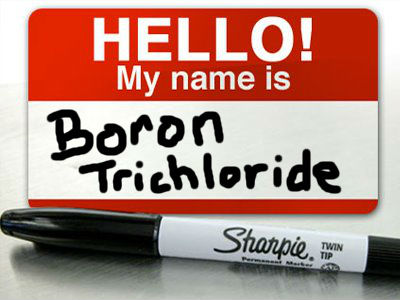
Hello. My name is Boron Trichloride.

Well, if your initials were BCl3 than it would be at least.
Today we begin Unit 5: Naming, and there is some good news and bad news to go along with that.
The good news is that there is not a lot of math, no formulas, no Avogadro’s number.
The bad news is that there are some tricky rules to what to name a compound when.

So, today we’ll be introduced to how to identify a Binary Compound. A Binary compound is any compound with two elements. When the second element is a Nonmetal, we replace the ending of the element with “-ide” (Like Carbon Dioxide). There are three types of Binary Compounds.

  1. Molecular Compound → Nonmetal + Nonmetal
  2. Ionic CompoundsMetal + Nonmetal
  3. Binary AcidsHydrogen + Nonmetal (The name begins with “Hydro” and the “-ide” at the end of the nonmetal is replaced with an “-ic”

Today we’ll be focusing on identifying the elements, determining if they are a metal (M) or nonmetal (NM), and identifying the type of compound. Here are a few examples:

Formula        1st Symbol      2nd Symbol      Type of Compound

ZnO               Zn (M)              O (NM)            Ionic Compound

BCl3               B (NM)             Cl (NM)            Molecular Compound

HBr                 H (Hydro)        Br (NM)           Binary Acid

Mole “Quest” Friday

We’ll continue working on our atom-mole-molecule calculations today. The goal is to have this done by Thursday to have time to prep for the “quest” on Friday. (It’s bigger than a quiz, but smaller than a test… it’s a quest, get it?)

These calculations can take time to do so be patient and be persistent. Check your work on the Semester 1 Docs page!

It’s Molection Day!

Okay seriously though this photo reminds us of two major events occurring today:

  1. It’s Election Day! It does not matter who you vote for, only that you vote! Mrs. Bassinger here and the rest of the social studies department will be putting on a mock-election. What a great way to exercise some good old American Patriotism. ‘Merica!
  2. Our Moles are due this week and some of them have already been turned in. The “Voting Mole” pictured here was a very clever idea. Check the “Photos” page for more of our creative creations!

Atoms – Moles- Molecules

This week we take the next step in the evolution of mole conversions. So far we have worked on one side of our graphic organizer or the other.

  • Mass of Atoms – Moles of Atoms – Atoms
  • Mass of Molecules – Moles of Molecules – Molecules

This week we connect the dots. This week you’ll be given a mass of molecules and work across the graphic organizer to get to mass of each atom that makes the molecule. ( For example: Mass P2O5 Molecules = Mass of P atoms + Mass of O atoms )

You’ll need to follow dome simple steps, which you have learned how to do in past lessons, in order to come up with your final figures.

  1. Calculate Molar Mass of the molecule (Multiply atomic masses by subscripts; add)
  2. Calculate the moles of the molecule (Given / molar mass)
  3. Calculate the moles of one of the atoms that make up the molecule (moles of molecules x subscript of atom)
  4. Calculate the mass of those atoms (moles of atom x atomic mass)
  5. Calculate the moles of the other atoms that make up the molecule (moles of molecules x subscript of atom)
  6. Calculate the mass of those atoms (moles of atom x atomic mass)
  7. Check your results with the law of conservation of mass (Mass of Molecules = Mass of atoms + Mass of atoms)


Moles to Molecules

We’ll be continuing our use of the Mole this week by using it to do calculations with entire molecules, not just atoms. So, we’ll be adding a whole new side to the chart that we started last week. See below.

If you’re struggling to remember how to calculate Molar Masses, search for the post on “molar mass” on this site. We’ll have a quiz over moles on Thursday and knowing how to use this chart to find the units you are looking for will be very helpful. There is also a homework assignment tonight (Grams to Moles to Molecules) which can be found on the “Docs” page. If you’re struggling with the calculations, watch the Voicethread.

1 mole = 6.022 x 10⁻²³ atoms = Atomic Mass

Lets say you have 2.5 moles of Au (Gold) and you’re really curious as to how many atoms of gold are in that sample. What should we do? Well just remember what Chemistry Cat says about MOLE PROBLEMS:

For any element or compound, 1 mole is equal to Avogadro’s Number of particles of that element or compound.

1 mole = 6.022 x 10²³

So, lets start plugging into a factor label equation the same way we did for Moles to Grams equations.

2.5 mole Au atoms   ->   __________  Au atoms

Since 1 mole is equal to Avogadro’s number, we can put that into our formula as…

6.022 x 10²³ Au atoms
1 mole Au atoms

So lets put this value into our formula and see if we can make this work…

2.5 mole Au atoms   x   6.022 x 10²³ Au atoms
1                                      1 mole Au atoms

We can cross out the “mole Au atoms” units so the only unit remaining is “Au atoms“. So…

2.56.022 x 10²³ Au atoms       =       1.506 x 1024 Au atoms

___________Easy! When you go from grams to moles you MULTIPLY BY THE ATOMS!_______________
But, what if I want to go from atoms to moles??? EASY!!! DIVIDE BY AVOGADRO’S NUMBER!
How many moles of Zn is 2.75 x 1024 atoms of Zn?

2.75 x 1024 Zn atoms   x   1 mole Zn atoms            4.57 mole Zn atoms
1                                      6.022 x 10²³ Zn atoms

Since, 1 mole of any element = Avogadro’s number of atoms (or molecules), you can flip the equation to work for you! Since we have moles on the top left of the formula, we want moles on the bottom right so they can cancel out!

Your homework for tonight is to finish the second 10 problems (the back side) of the  Moles Conversions Worksheet (found on semester 1 Docs). You can also watch the Voicethread on mole conversions using the App or the semester 1 Notes Page.

Moles to Grams… Grams to Moles

After the excitement of MOLE DAY, it’s time to actually start using those friendly moles to our benefit. Today, we’ll be finishing the third part of our Mole lab with Cu/Fe. As a part of that lab, we’ll need to calculate how many moles of Cu/Fe were produced using the amount of grams of each.

To calculate grams to moles we use the FACTOR LABEL method. Let me show you what I mean…

Lets say you weighed your sample and have 105.5 g Cu atoms (Its important to label your values this way for future use; we’ll always add the element and “atoms” after the unit) and we want to know how many moles that is. well what do we know…

105.5 g Cu atoms   ->   ??? mol g Cu atoms

Well… lets think about this. Do we know how many grams are in 1 mol Cu atoms so we have something to compare this to??? Let’s look at our handy-dandy periodic table; find Cu; the atomic mass listed there is equal to the weight of 1 mol Cu atoms!

1 mol Cu atoms
63.5 g Cu atoms

So lets put this value into our formula and see if we can make this work…

105.5 g Cu atoms   x  1 mol Cu atoms
1                                  63.5 g Cu atoms

We can cross out the “g Cu Atoms” units so the only unit remaining is “mol Cu atoms“. So…

105.5 x 1 mol Cu atoms       = 1.66 mol Cu atoms
63.5

___________Easy! When you go from grams to moles you DIVIDE BY THE ATOMIC MASS!_______________
But, what if I want to go from moles to grams??? EASY!!! MULTIPLY BY THE ATOMIC MASS!
What is the weight of 2.5 moles of Carbon atoms?

2.5 mol C atoms x 12.0 g C atoms  30.o g C atoms
1                           1 mol C atoms

Since, 1 mole of any element = atomic weight of that element, you can flip the equation to work for you! Since we have moles on the top left of the formula, we want moles on the bottom right so they can cancel out!

Your homework for tonight is to finish the first 10 problems (the front side) of the Grams to Moles Conversions Worksheet (found on semester 1 Docs).