

Today we’ll be finishing Handout #2 (Which you should have started yesterday). You will have a quiz tomorrow… and it is currently posted on the Docs page and below this clever sign. Have a Happy Valentines Day!

Today we’ll be finishing Handout #2 (Which you should have started yesterday). You will have a quiz tomorrow… and it is currently posted on the Docs page and below this clever sign. Have a Happy Valentines Day!

I’ll be visiting my dentist this morning so I won’t be in my morning classes. But here’s a rundown of what is happening today.
Remember, there’s shortened periods today for our Ash Wednesday Mass.

This is how I feel when I try something new… this is probably how you feel looking at Stoichiometry problems…
For those of you that aren’t privileged enough to be in our class, this is the presentation of Stoichiometry.
We’re gonna push some boundaries today. Its the only way we grow. So besides the youtube video, I’m posting a flash version of the notes. I’m not sure if it will show up on the iPads but I know it works on desktops and laptops. The voicethread is still available, but my thought was that you might want to be able to see the numbers slide and appear in their specific places. Hope it works…
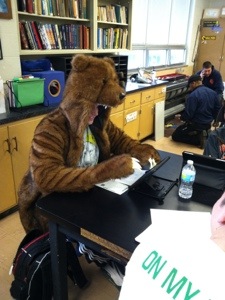
He’s Bear-ly Working…

The link to the answer key to your study guide was note posted correctly this weekend. I’m sorry for any trouble this may have caused your to your studying. The test is still today and the answers are now posted. Good Luck.
 The Day After – The Day After – The Superbowl is our test day. I feel like we’re pretty good with Balancing Reactions (Be careful with those combustion reactions) but we need to get better at Identifying the type of reaction based on the reactants. That was the goal if the voicethread project, to review the types and make connections. Now will be your chance to prove it…
There will be a review packet on “Predicting Types of Reactions” to work on today. It will be due Friday (remember tomorrow we’re in the lab). The answers will be posted mid-day today SO CHECK YOUR WORK! Don’t just copy!
Why is it Super Week?
Well because we’re Super excited about Types of Reactions… duh. Yeah… right. Seriously though, this could be a Super Week for you. We originally had scheduled our Types of Reactions test for this coming Thursday… BUT! because we did such a great job in the lab last week, we’re going to push back the test and do another Lab this Thursday instead. So this is a look at your Super Week…
Monday – We’ll start our VoiceThread Review Project. Due Tuesday Night
Tuesday – We’ll complete our Voicethread Review Projects. Due by 11:59pm
Wednesday – We’ll start our Review Packet with information and practice problems (Due Friday)
Thursday – Lab Day
Friday – Review Day
Sunday – Super Day (Go Niners!)
Monday – Day after Super Day (No School in recognition of the Football State Championship)
Tuesday – Test Day ( I know, I hate tests after a weekend too. But you can use that day off to prepare)
Now, on that note, today we’ll be starting our Voicethread review projects. The link to the document is available below and on the semester 2 docs page. It is worth 20 pts and is due tomorrow before 11:59pm.
Ha Ha, very fun (*not laughing… ok, maybe a chuckle). That was not the ‘Double’ I was talking about. I was talking about Double Replacement Reactions. They’re a lot like single replacement reactions… but EASIER!
This is the basic set up of a Double replacement reaction:
Another way to visualize this would be this set up…
That’s pretty much it. Other than the subscripts, which like all Ionic Compounds are determined by the charges. Remember the rules:
And just like that, you now know the 6 types of Chemical reactions!

We’ll be doing a Lab tomorrow and start reviewing next week. Plan on the test over chemical reactions being Next Thursday!
Today we’ll be discussing single replacement reactions. Single Replacement reactions always follow this format:
Another way to think of them would be this…

So Here’s how it works. We’ll use the Reactants Zn + Cu(NO3)2 → As our example
Step 1: Identify the element as either a Metal or a Non Metal.
– For our reaction Zn (Zinc) is a metal. So, we’ll write ‘Metal’ under Zn
Zn + Cu(NO3)2 →
Metal –
Step 2: Determine the charge of the Element.
– For our reaction, Zn has a charge of +2. So we’ll write that below ‘Metal’
Zn + Cu(NO3)2 →
Metal –
+2 –
Step 3: Seperate the Ionic Compound into Cation and Anion and determine the charges
– In almost all Ionic compounds the Cation is listed first, and it’s almost always a Metal (except when it’s ‘H’)
Zn + Cu(NO3)2 →
Metal Cat. An. –
+2 +2 -1 –
Step 4: If the Element is a Metal then it will replace the Cation; It will replace the Anion if it was a Nonmetal.
– For our example, Zn will replace the Cu. The other element is left standing alone in it’s elemental form.
– Remember the charges will determine the subscripts. In this case, Zn has a charge of +2 and since NO3 has a charge of -1, it takes 2 NO3‘s to make the charges balanced.
Zn + Cu(NO3)2 → Zn(NO3)2 + Cu
Metal Cat. An. –
+2 +2 -1 –
That’s all folks.

Seriously though, we’ll be talking about Combination reactions today and believe it or not they’re not that bad. Let me show you.
Combination reactions always follow this pattern:
1 Compound + H2O → 1 Compound
They’re really easy to balance, but you have to know which type of combination reaction you’re working with before you can start.
1. Metals – If the compound in the reactants is a metal and Oxygen, these are the steps you follow:
1. You must determine the charge of the metal. To do this, separate the compound and use your periodic table or the crossing rule (If the compound has subscripts, that may be the charge of the opposite atom). Lets look at this example:
CaO + H2O →
↓ ↓
+2 -2
Looking at the periodic table we see that Ca has a charge of +2 and O has a charge of -2
2. Now that we know the charge of the metal, we “Combine” that metal with Hydroxide (OH-). The number of hydroxides is determined by the charge of the metal.
CaO + H2O → Ca(OH)2
↓ ↓ ↑ ↑
+2 -2 Ca+2 (OH)-1
In our example, we need 2 (OH) ions to balance the -2 charge of Ca
3. That’s it! It’s that simple. And all you would have to do now is balance but even that is pretty easy. In fact, this one is already balanced!
1. Nonmetals – If the compound in the reactants is a Nonmetal and Oxygen, these are the steps you follow:
1. When a nonmetal oxide reacts with water it forms an Oxoacid (Remember, oxoacids start with H and end with a polyatomic ion). So to do this you simply add all the H’s, add all the nonmetal atoms, and add all the O’s. Those numbers become the subscripts of your Oxoacid. For example:
CO2 + H2O →
Just add the H’s (2), the non metal in this case is C (1), and the O’s (3). Then combine them into one Oxoacid:
CO2 + H2O → H2CO3
DONE! HOW EASY WAS THAT!
The only exception would be if the answer does not have a Polyatomic Ion, but the subscripts all have a common denominator, you make the common denominator the coefficient and reduce the subscripts. For example:
N2O5 + H2O → H2N2O6
Well there is no Polyatomic Ion that is N2O6 But all the subscripts are divisible by 2! So 2 becomes the Coefficient!
N2O5 + H2O → 2 HNO3
So that is Combination Reactions. Hope you learned something and don’t end up like this guy…

 MrKubuske.com