Are you Smarter than a 6th Grader?

Obviously you are, otherwise you’d still be there right?

Seriously though, today we’ll begin collaborating on and producing some type of presentation to introduce 6th graders to the concept of evolution. Now, there are lots of ways to go about this, but to get you started here are some things to keep in mind:

  1. Importance Choose information that is, what you consider, the most important and relevant information they need in order to grasp the concept.
  2. ConnectionsProvide them with images, real world connections, and other materials that will make it easier to understand what you are trying to show them.
  3. Terms What terms will you be using that they do not know? How will you provide them with a definition they can understand?
  4. Creativity/EnthusiasmIf you are not excited about what you are doing, or what you are creating, it will show in your final product and your students will know it too!
    • No Power Points & No Videos of You Reading From a Script If it would bore you as a student, why would you make someone else suffer through it?

Along with your product, you will need to have a journal that is kept each day to track your activities, progress, and estimated completion date. This is done on an individual basis and will only be seen by your instructor.

The project is based on a grade of 100 points, and there are further directions and a rubric available using the link below, or on the Semester 2 Docs page.

Evolution Project PDF

My last warning to you will be to stay diligent and to be efficient. Make a plan and execute the plant. Focus on the details but do not let them consume you. Remember you are a part of a group/team and there are others counting on you to do your duty. Good luck and have fun!

VSEPR Theory ’14

Now that we know how to find the general structure of a molecule using Lewis Dot diagrams, we can actually find the three-dimensional shape of a molecule AND BUILD IT! We can find the shapes of molecules using the VSEPR (Valence Shell Electron Pair Repulsion) Theory.

The idea is that atoms and electrons found around a central atom are repelled by each other because of the negative charges of the electrons surrounding each (remember opposites attract +/- and similar charges repel -/- or +/+). In other words, everything bonded or attached to the central atom wants to be as far away from everyone else as possible.

So let’s look at NH3 for example.

Step 1: Calculate the valence electrons

1 x N = 1 x 5 = 5
3 x H = 3 x 1 = 3       5+3 = 8 ve

Step 2: Draw the Lewis Dot Structure

Step 3: Calculate the ABE type

Each letter of ABE stands for a part of the molecule
A= A central atom. If it has a central atom, write an A
B= Attached atoms. Count the number of atoms attached to the central atom and write that as a subscript of B example: B3
E= Free Electron Pairs. If their are extra electron pairs on the central atoms we count them as pairs and write that as a subscript of E (if there are no pairs, do not write E. If there’s only 1 pair, just write E) example: E2

NH3 has a central atom, three attached atoms, and 1 electron pair. So the ABE structure would be AB3E

Step 4: Find the Ideal Geometry.

I like to think of the ideal geometry as places on the central atom with thing happening. If there is only 2 places where things are happening (attached atoms or free electrons) then it’s Linear. If there’s three places, it’s Trigonal. If there’s four, it’s Tetrahedral.

Below is a great link to a video explaining the different shapes and where they come from.

Since NH3 is an AB3E structure there are 4 places where things are happening (B 3 + 1 E) so NH3 is Tetrahedral.

Step 5: Molecular Shape.

NH3

Along with the ABE chart is the list of Ideal Geometry and Molecular shape. The shape is based on the idea that the other atoms want to be as far apart as possible AND that free electron pairs need a lot of space to roam.

NH3 has 1 free pair of electrons that float to the top of the molecule as if they were in a balloon. The three Hydrogens then act as a tripod for the entire molecule holding it up. Therefore we say the shape of NH3 is pyramidal.

Now that you have completed the simple VSEPR diagrams and made your models of Linear, Trigonal, and Tetrahedral molecular geometry… it’s time to break the rules…

The rule we’re breaking is the Octet rule. To this point you have limited the central atom to sharing up to 8 electrons. But, If your Lewis Dot Diagram has too few electrons, you add pairs of electrons to the central atom.

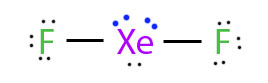
XeF2

Let me show you what I mean. Let’s say that we have XeF2.If you calculate the valence electrons you should have 22.
But when you make the Lewis Dot Diagram, it only has 20 ve.

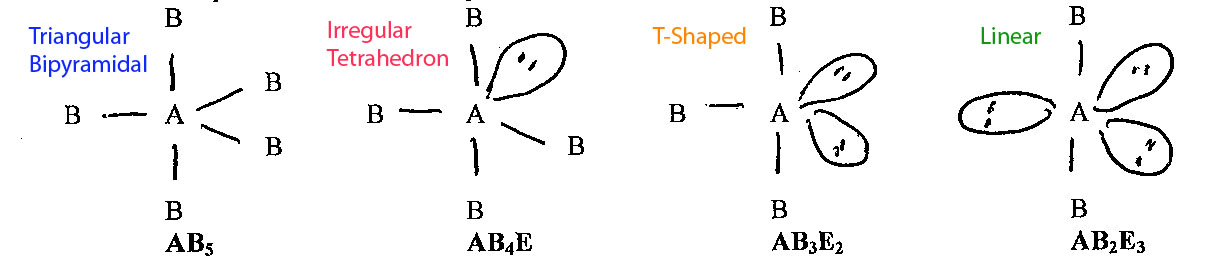
So, we add a pair of electrons to the Xe central atom giving us a total of 22 veXeF22This creates a new Ideal Geometry known as Triangular Bipyramidal, which means it has placement for 5 parts (attached atoms or free electron pairs) around the central atom.

TriangularBipyramidalLike Tetrahedrons, we are working now in 3-dimensions instead of 2.

There is also an Ideal Geometry for 6 parts known as Octahedron. Think of the central atom as a 6 -sided die. So atoms can be bonded in 6 places and in 3-dimensions!

Octahedron

Orbital Diagrams

To complete today’s assignment (the answers are posted BTW), you’ll need the following information about Orbital Diagrams. These are the rules that dictate where electrons go and how they spin.

1. Hund’s Rule: One electron is placed in each orbital of an electron shell BEFORE a second one is put in any of the shells. (AKA – The Bus Seat Rule)

    • Correct: ↑↓  _   _  _  _
    • Incorrect: ↑↓  ↑↓  ↑↓  __  __

2. Aufbau Principle: Each shell must be completely filled before beginning to fill the next shell

  • Correct: ↑↓      ↑_   ↑_  ↑_
  •              3s        3p
  • Incorrect: __    ↑↓  ↑↓  ↑_
  •                3s          3p

3. Pauli Exclusion Principle: Electrons in the same orbital spin in opposite directions

  • Correct: ↑↓
  • Incorrect: ↑↑

Thursday’s Plan

I’ll be out of the classroom Thursday and Friday. Each day I’ll post the plan on this site and all the activities and links can be found on the Semester 2 documents page.

Biology:

Complete the “Despicable Me” & “Gnomeo & Juliet” Activities for complete and incomplete dominance. Each is due monday but you can turn them in tomorrow.

Chemistry:

Work on your Elemental Dating project. Remember there are three parts to the assignment. If you are ready to start your video, make a Bohr Model of your element and use that to make your video.

While you’re at home enjoying your “wind chill” day

Actually Kitty, It’s a “Wind Chill” Day

I’m sure this was you last night when you found out school would be cancelled. But… instead of sitting around in your PJs taking selfies all day, maybe you should be studying for your upcoming tests. Because of the day off we’ll adjust the test dates.

Biology – Unit 7 (Reproduction) Test: Friday, January 31st.

#hbio students, your study guide is now available: Bio Unit 7 Study Guide – PDF

Chemistry – Unit 7 (Stoichiometry) Test: Monday, February 3rd

Stay Warm and be safe if you’re treking outside.

Here it goes again…

Ok, you may be to young (or uncool) to know that song lyric, but regardless here we go on to semester 2! We’ve reached the halfway mark but we have a long haul left. In both Chemistry and Biology we have 5 units left to complete this year.

For the rest of the year, make sure you use the “Semester 2” links below the class tabs to reach the content we’ll be doing in class (and for those of you just joining us, you can find class rules and procedures there as well).

Biology: Unit 7 – REPRODUCTION: 

We’ll be covering chromosomes, types of reproduction (careful…), Mitosis, Meiosis, Karyotyping and Genetic Disorders

Chemistry: Unit 7 – Stoichiometry:

Possibly the most important unit in chemistry, especially if you plan on continuing with chemistry in future classes or as a major/profession.