The Unit 7 Hunger Games

Today in #hbio we’ll be reviewing for Wednesday’s test over Unit 7. To review, you’ve been selected to be Tributes in the Unit 7 Hunger Games!!! Ok, so its not life or death survival of the fittest, instead we’ll be doing a speed stations activity. There are 32 stations posted throughout the room. You and a partner will try to complete these stations as ACCURATELY & QUICKLY as possible. You are Competing against the other players in your class. The fastest, and the most accurate, will receive a bonus point.

At the end of the day, I will post the stations on this site for you to review with. Be sure to study your Unit 7 Study Guide as well. Good Luck, and may the odds be forever in your favor…

Unit 7 Review: Answer Sheet – Link –

DNA Replication Models

Today in Bio, we’ll be starting our work on our Replication Models. They are great visuals of how the process of replication actually looks. In order to complete the model you will need the following:

dnahelicaseThis is a large undertaking and will take us a few days to complete. To keep track of our progress there are checkpoints listed in the directions as well as a photo journal to keep. The photo journal should include several pictures of you and your group working as well as a description of what is taking place on your model.

When you are finished, you will hang your model somewhere in the school building for all to see. Then snap a picture of it hung up and email it to me, along with your completed photo journal, at jkubuske@gocathedral.com

If you need a refresher of how DNA replication works, here are the notes from the other day. Have fun and good luck!

The DNA (web quest) Puzzle

Today we’ll begin our long journey through the amazing world of DNA.
As we begin to look forward to a fun filled few weeks, its at this point that we look back into the past and discuss the important people who’s contributions and life’s work answered some of life’s biggest questions.

If you are using Puffin: Go to http://www.DNAi.org and click timeline, there you will a see a list of scientists broken up by decade. Use the web quest to determine which scientists to look up. You can read their biographies by clicking their picture. You can also have them tell you their story by clicking the animated icons above them.

If you are not using Puffin: Below are videos that are taken from the website DNAi.org. Use them to complete the introduction to these scientists as a part of this webquest (PDF).

  • Friedrich MeischerBio
  • Erwin Chargaff – Bio
  • Rosalind Franklin – Bio
  • Alfred Hershey & Martha Chase – Bio
  • James Watson & Francis Crick Bio

Together the contributions come together to fit like pieces of a puzzle (Read Here) and the shape of the DNA molecule was finally uncovered.


Cell Transport Review!

Cell Membrane:

  • The Cell Membrane
  • Phospholipid
  • Phosphate Head
  • Fatty Acid Tail
  • Semi-Permeable
  • Transport Protein
  • Marker Protein
  • Receptor Protein
  • Lipid Bilayer


Passive Transport (Diffusion & Osmosis):

  • Passive Transport
  • Passive Transport
  • Equilibrium
  • Diffusion
  • Facilitated Diffusion
  • Osmosis
  • Aquaporin
  • Isotonic
  • Hypotonic
  • Hypertonic
  • Concentration Gradient

Active Transport (& ATP)

  • Active Transport
  • Active Transport
  • ATP –Adenosine Triphosphate
  • ADP –Adenosine Diphosphate
  • Sodium-Potassium Pump
  • Exocytosis
  • Endocytosis
  • Phagocytosis
  • Pinocytosis

Origin of Eukaryotes

3pxff (1)

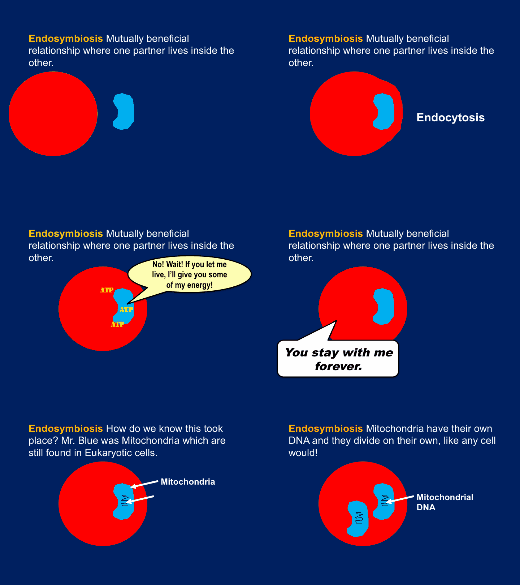
Yesterday we discussed prokaryotes; their characteristics and examples. Today, we’ll examine the eukaryotic cell and its characteristics. But, before we do, lets take a moment to theorize where Eukaryotes evolved from 1.5 billion years ago.

For today’s warm up, do the “Endosymbiosis” worksheet (pg.41 in yesterday’s packet)

Key ← Use it as a resource, not to copy

Then we’ll be taking some time to learn the parts of a Eukaryotic cell. Please watch the YouTube Video or open the PPT in Keynote to complete the “Cell Part Chart” in a paper format or as a PDF.

Tomorrow, we’ll review the types of cells as well as this chart and the parts of a Eukaryotic cell.