Students, I hate to tell you bit I have to be out one more day to comfort my family and make my way back to Indiana.
In the mean time, I need you to take notes to answer these three questions for Biology:
What impacts do human’s have on their environment?
What causes ‘climate change’?
What is an ‘invasive species’ and how is it harmful to an ecosystem?
Use the PPT provided, use your eBook, and/or watch the YouTube video on the topic to answer these questions. Tomorrow we’ll be playing a game related to the topic of Human Impacts on ecosystems and you’ll need these notes done to participate.
When you have the notes completed use the notes and pages 314-323 in your ebook to answer questions about 4 ‘case studies’ which can be used to show the principles of ecology. Your job will be to use the information on these pages to answer questions about each case study from the pdf below. The 4th case study, about invasive species, is found in the second pdf below.
I’m sorry to say but I will not be with you in class on Monday or Tuesday. I’ll be in Ohio honoring my grandfather who passed away this weekend. He was a great man who defended his country, raised a family, and improved his community. He led a full happy life and he will be forever loved and missed.
So I’m going to leave some directions on what I need you to do for me while I’m gone so we can pick up right where we need to on Wednesday. Theres no handout because I did not have an opportunity to make any copies before i had to leave town. So if you want handouts they are available as pdf’s from the semester 2 documents page. Thanks for your help and understanding.
Front row, 2nd from the Right. In front of his B-17 Bomber “Little Dinah” in 1943
Biology
Over the next Two days please get the following items accomplished. Feel free to do them in any order you wish.
Biome Books are Due Tuesday. Feel free to use Monday’s class to work on them.
Cycles Notes. I need you to get information on three of the major biogeologic cycles (Carbon, Nitrogen, & Water). I have placed images for each of the cycles on the documents page as well as using the links below. Study the images and take notes on them as needed. When you are ready, answer the three questions below using information you discerned from the images.
(Water) As I got a drink from the drinking fountain at school, my teacher told me I was drinking the same water a dinosaur did 65 million years ago. Is he right or is he just messing with me? and how can I prove this?
(Carbon) What roles do humans play in the Carbon cycle (at least three)?
(Nitrogen) Why is my grass always greener after a thunderstorm… even if it doesn’t rain that much?
Cycles Review (pdf). After taking the notes, and either before or after answering the three questions, do this worksheet to check your understanding of the material. The key is posted on the Semester 2 Documents page.
On wednesday we’ll start discussion of Human impacts on the environment so you’ll need to know these cycles so we can discuss how we as humans disrupt them.
Chemistry
Please continue to work on your gas laws unit. You should be somewhere between #7-10 by the end of this week to be on a good pace. Some of you are still lagging behind…
Thank you again for your understanding and I’ll see you Wednesday. – Mr. K
I’ll be out today doing some professional development over at Fatima. If you need me, send a quick email. Otherwise, you are working in an open classroom at your own pace. Please be respectful of the substitute and work on something during class even if it is not something related to our class. Enjoy the great weather and have a good day!
Biology
Biome Books – Due Monday
Interdependence Notes – Must be completed before class tomorrow
Interdependence Guided Practice – Can be done anytime today or tomorrow but not until notes are done
Wolf/Moose Article – On the back of the guided practice (or the first page of the lab pdf)
Predator/Prey Lab – Done in class on Friday. Will take approximately 30-40 minutes to complete. Lab report due Monday but can be turned in Friday
Chemistry
Continue working on the open classroom format. As you complete activities, show the sub you have them done (check your own work online) and have him initial your work. Keep in mind it is up to you to control your learning so if you choose to cheat the system and copy work to get extra sections done it will only hurt you in the long run.
Check out some of the amazing work our Honors Biology students created to share with some local middle school students to help them learn the basics of Evolution:
Some of the students created twitter accounts for middle schoolers to follow and included key concepts as well as #hashtagvocab!
Divergent is the accumulation of differences between groups which can lead to a formation of a new species. pic.twitter.com/cWj8AP7j5w
— Evolution (@BIOevolutionary) March 25, 2014
Today we’re going to begin studying Gas Laws… (and that doesn’t mean the rules on Dutch Oven or letting one go in a crowded elevator).
We’re going to try some new classroom techniques for this final unit and create an “Open” classroom. Below are the expectations of you the student and of me the teacher.
Describe and site4 examples of how gases are different than solids and liquids at the molecular level.
Completeeach of these conversions: atm → mmHg // atm → kPa // atm → torr
2. Boyle’s Law
DescribeBoyle’s Law
Complete4 problems using Boyle’s law
Write out an explanation of how you can remember the formula for Boyle’s Law.
3. Charles Law
DescribeCharles law
Complete 4 problems using Charles’ law
Watchthis video and write an explanation of how it proves Charles’ Law.
4. Gay-Lussac’s Law
DescribeGay-Lussac’s law
Before receiving completion for this section you should have: Postedat least 1 source of your information (that was not previously posted) , with your name to the Google Doc… OR… Posta question you have and/or Posta response to another students question.
5. Combined Gas Law
Complete 4 problems using the Combined Gas Law.
Write and submit an explanation of what the combined gas law is and why it is useful in the box below. You can see the text from other respondents by clicking this link. Combined Gas Law Responses
6. Standard Temperature & Pressure (STP)
Complete2 problems using the Combined Gas Law at STP.
Writea Definition of Standard Temperature & Pressure.
7. Universal Gas Constant (R)
Find ‘R’s value for :
L·Torr/mol·K (L·mmHg/mol·K)
liter·atm/mol·K
Determine what formula is ‘R’ used in.
8. Ideal Gas Law: Volume
Write out the formula of the Ideal Gas Law.
Complete4 problems finding the value of the Universal Gas constant using the Ideal Gas Law.
9. Ideal Gas Law: Moles
Determine how many liters are equal to 1 mole of any substance at STP (#19 on the Gas Laws Calculations)
I know you are anxious to get out of the building and spend a week away having fun on spring break. Before you go though, I have a couple of questions about how you want to spend the next 3 weeks studying Ecology. Do me a favor and read the questionnaire below and answer the questions fully and honestly. After that, have a great break…
P.S. – We can’t wait to see your evolution projects on April 7th!
Obviously you are, otherwise you’d still be there right?
Seriously though, today we’ll begin collaborating on and producing some type of presentation to introduce 6th graders to the concept of evolution. Now, there are lots of ways to go about this, but to get you started here are some things to keep in mind:
Importance– Choose information that is, what you consider, the most important and relevant information they need in order to grasp the concept.
Connections – Provide them with images, real world connections, and other materials that will make it easier to understand what you are trying to show them.
Terms– What terms will you be using that they do not know? How will you provide them with a definition they can understand?
Creativity/Enthusiasm – If you are not excited about what you are doing, or what you are creating, it will show in your final product and your students will know it too!
No Power Points & No Videos of You Reading From a Script – If it would bore you as a student, why would you make someone else suffer through it?
Along with your product, you will need to have a journal that is kept each day to track your activities, progress, and estimated completion date. This is done on an individual basis and will only be seen by your instructor.
The project is based on a grade of 100 points, and there are further directions and a rubric available using the link below, or on the Semester 2 Docs page.
My last warning to you will be to stay diligent and to be efficient. Make a plan and execute the plant. Focus on the details but do not let them consume you. Remember you are a part of a group/team and there are others counting on you to do your duty. Good luck and have fun!
Now that we know how to find the general structure of a molecule using Lewis Dot diagrams, we can actually find the three-dimensional shape of a molecule AND BUILD IT! We can find the shapes of molecules using the VSEPR (Valence Shell Electron Pair Repulsion) Theory.
The idea is that atoms and electrons found around a central atom are repelled by each other because of the negative charges of the electrons surrounding each (remember opposites attract +/- and similar charges repel -/- or +/+). In other words, everything bonded or attached to the central atom wants to be as far away from everyone else as possible.
So let’s look at NH3 for example.
Step 1: Calculate the valence electrons
1 x N = 1 x 5 = 5 3 x H = 3 x 1 = 3 5+3 = 8 ve–
Step 2: Draw the Lewis Dot Structure
Step 3: Calculate the ABE type
Each letter of ABE stands for a part of the molecule
A= A central atom. If it has a central atom, write an A
B= Attached atoms. Count the number of atoms attached to the central atom and write that as a subscript of B example: B3
E= Free Electron Pairs. If their are extra electron pairs on the central atoms we count them as pairs and write that as a subscript of E (if there are no pairs, do not write E. If there’s only 1 pair, just write E) example: E2
NH3 has a central atom, three attached atoms, and 1 electron pair. So the ABE structure would be AB3E
Step 4: Find the Ideal Geometry.
I like to think of the ideal geometry as places on the central atom with thing happening. If there is only 2 places where things are happening (attached atoms or free electrons) then it’s Linear. If there’s three places, it’s Trigonal. If there’s four, it’s Tetrahedral.
Below is a great link to a video explaining the different shapes and where they come from.
Since NH3 is an AB3E structure there are 4 places where things are happening (B 3 + 1 E) so NH3 is Tetrahedral.
Step 5: Molecular Shape.
Along with the ABE chart is the list of Ideal Geometry and Molecular shape. The shape is based on the idea that the other atoms want to be as far apart as possible AND that free electron pairs need a lot of space to roam.
NH3 has 1 free pair of electrons that float to the top of the molecule as if they were in a balloon. The three Hydrogens then act as a tripod for the entire molecule holding it up. Therefore we say the shape of NH3 is pyramidal.
Now that you have completed the simple VSEPR diagrams and made your models of Linear, Trigonal, and Tetrahedral molecular geometry… it’s time to break the rules…
The rule we’re breaking is the Octet rule. To this point you have limited the central atom to sharing up to 8 electrons. But, If your Lewis Dot Diagram has too few electrons, you add pairs of electrons to the central atom.
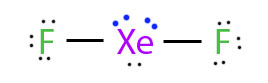
Let me show you what I mean. Let’s say that we have XeF2.If you calculate the valence electrons you should have 22.
But when you make the Lewis Dot Diagram, it only has 20 ve–.
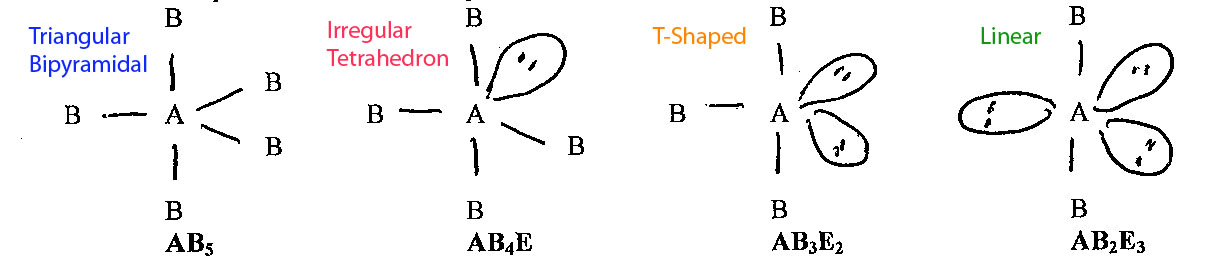
So, we add a pair of electrons to the Xe central atom giving us a total of 22 ve–This creates a new Ideal Geometry known as Triangular Bipyramidal, which means it has placement for 5 parts (attached atoms or free electron pairs) around the central atom.
Like Tetrahedrons, we are working now in 3-dimensions instead of 2.
There is also an Ideal Geometry for 6 parts known as Octahedron. Think of the central atom as a 6 -sided die. So atoms can be bonded in 6 places and in 3-dimensions!
Believe it or not, we actually have was of finding this answer despite the fact the Tyrannosaurus Rex has been extinct for over 65 million years. We can determine a T-Rex features, including taste, using similar features (which we now know are called homologous structures). shared with animals the T-Rex is closely related to.
Recall that yesterday we learned that the more features you have in common, the higher the probability that you share a common ancestor/DNA (the exception would be convergent evolution where two species become increasingly similar despite the fact the originated from different ancestors). So what we can do is plot relatedness, based on characteristics, on a graphic called a cladogram, like the one shown here.
So Today, that’s exactly what we’ll be doing, using the link at the top of this post, you’ll follow the steps to learn how cladograms are created, organized, and what the different branches of it mean. By the time you are through, you will know what it tastes like to bite into a big fat dino-burger!


 I’ll be out today doing some professional development over at Fatima. If you need me, send a quick email. Otherwise, you are working in an open classroom at your own pace. Please be respectful of the substitute and work on something during class even if it is not something related to our class. Enjoy the great weather and have a good day!

 Obviously you are, otherwise you’d still be there right?
 Now that we know how to find the general structure of a molecule using Lewis Dot diagrams, we can actually find the three-dimensional shape of a molecule AND BUILD IT! We can find the shapes of molecules using the VSEPR (Valence Shell Electron Pair Repulsion) Theory.




 MrKubuske.com