Characteristics of Life

Over the next few days, until our Test on Monday, we’ll be studying the 8 characteristics of life. You should know the description of each, any vocabulary associated, be able to provide an example, and assess how each characteristics relates to the others.

  1. Cells
  2. Metabolism
  3. Reproduction
  4. Homeostasis
  5. Evolve
  6. Heredity
  7. Respond to Stimuli
  8. Growth/Development

Warm Up Quiz 8/16

Chemistry class: Click here for your Quiz

Biology: Complete the form below

If the quiz does not appear below, Go to http://www.google.com/drive and log in. After logging in, come back to this site and refresh the page. When you finish the Quiz, email me your ‘Note’

The Scientific Method

Biology students, today will be our first time taking “Notes”, although today’s notes will be more of a review of a concept than the introduction of a concept. On the Bio- Semester 1 page, you’ll find a link to the video below as well as to the handout that corresponds to it. I would encourage you to decide today how you plan to take notes in class (notability or paper), and then decide how best to redo the notes neatly and orderly on notability or on the paper version (yes this means you will be writing the notes twice).

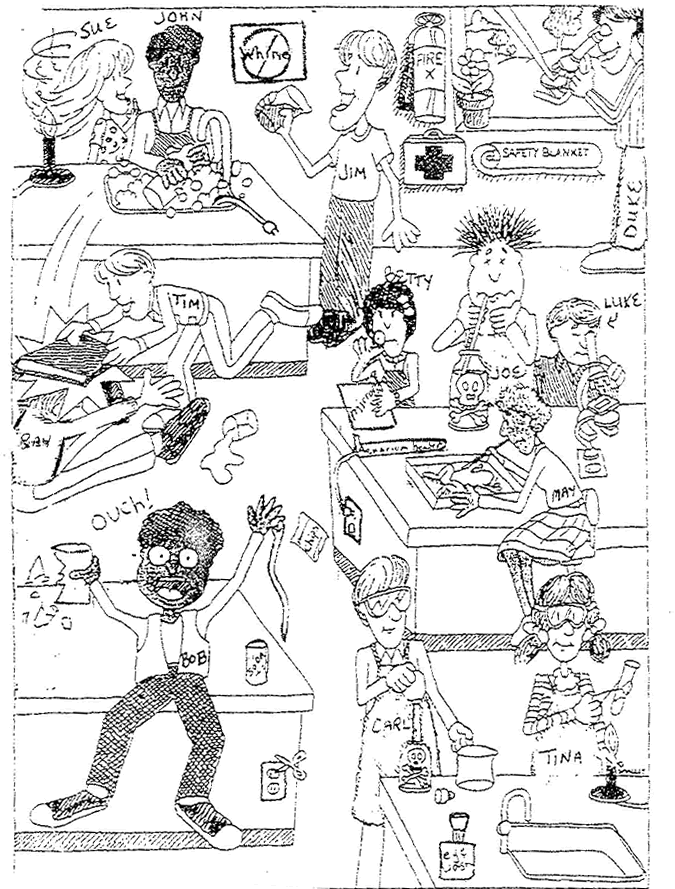
Lab Safety… it’s no Accident

Today we’ll be going over some important information about your safety in a Lab setting. After review the Lab Safety rules (check the documents page for your specific class for a PDF version), take a look at the image below. See if you can spot some incidences of failing to follow lab procedures for safety.

Reminder there will be a “Common Sense” Lab Safety Quiz tomorrow for Biology and Chemistry

Your iBook

Below is a description of how to download you iBook to your iPad. It will take some time to download, so please do not begin the download until you are in a place where you can be connected to wifi and a power source for up to an hour.
The book will be a valuable resource for you to refer to as well as for us to use in class.

Biology:

  • Open your iBooks App
  • Click ‘Store’ in the top left
  • When the store opens, click the tab at the top that says ‘More’
  • Scroll through that drop-down menu and find textbooks
  • When that page opens, scroll down until you see ‘Life Sciences’
  • The textbook we will use is called “Biology” and is $14.99

Chemistry:

  • Open your iBooks App
  • Click ‘Store’ in the top left
  • When the store opens, click the tab at the top that says ‘More’
  • Scroll through that drop-down menu and find textbooks
  • When that page opens, scroll down until you see ‘Physical Sciences’
  • The textbook we will use is called “Chemistry” and is $14.99

First Day of School

I know… I feel the same way.

Welcome to Mr. Kubuske’s Class Blog. First, please set a bookmark or a link to your home screen. After that feel free to browse this page. At the top are links to class pages where notes, assignments, and documents will be posted for you to download as we work through our curriculum. There’s a page for students, a page about Mr. K, and a soon to come weekly agenda page. On the right is links to my twitter and other info that will help you.

Next, there are 3 papers on the back lab table I’d like you to pick up. You will need to bring these papers back to class tomorrow so put them in a safe place. Eventually, these papers will need to go in your Class 3-ring binder.

Last, for today’s class activity, you’ll need to get a piece of string. The strings are on the old pencil sharpener near the bookcase. Please go ahead and pick up a piece of string and come back to your seat. At that point please put all your papers and other materials away and wait for further instructions.

As a reminder, you will need to download your iBook at home or in a place where you can be on a wifi network for a long period of time.

Thanks for participating and we look forward to working with you this year!

Unit 10: Gas Laws

Today we’re going to begin studying Gas Laws… (and that doesn’t mean the rules on Dutch Oven or letting one go in a crowded elevator).

We’re going to try some new classroom techniques for this final unit and create an “Open” classroom. Below are the expectations of you the student and of me the teacher.

Student Values:

  1. You are encouraged to collaborate (share) ideas, information, and how to complete problems with fellow classmates. This means sharing information, not giving answers. The point of collaboration is to better understand the material ourselves and be of service to a colleague. The only thing you may not share are the puzzle pieces; they must be received individually and documented by the instructor.
  2. If you are sharing a resource digitally on the blog or Google Doc you should use your first initial and last name to identify you. Posing as another student is considered fraudulent and does not follow the mission of the school. Any student posing as a colleague will face loss of points and other possible disciplinary actions.
  3. You are tasked with completing 10 topics before you are permitted to attempt the final test. For each topic you complete, you will receive a piece of the puzzle that you are literally and figuratively completing during this unit. You may work at your own pace provided you meet the deadlines set by the teacher.
  4. Since you will be permitted to use the internet and technology as you see fit, you may come across material that is inappropriate for a high school. When this occurs, close your iPad and raise your hand. Do not draw attention to yourself or share the text or images with others.
  5. You are permitted to move about the room as needed to complete tasks and collaborate with colleagues. But in a working environment you must respect the workspace and work ethics of those colleagues by not becoming a distraction.

Failure to follow these values will result in a deduction of points from your Unit 10 score.

Gas Laws Puzzle .pdf (Download to Noteability)

Teacher Values:

  1. Be of service to my students by providing a framework digitally and within the classroom to allow for free flow of ideas and learning.
  2. Provide guiding questions to show students direction they should look to complete their sections.
  3. Be available for mentoring and guidance through challenging material.

As you complete each section you will be asked a set of questions to prove your knowledge of the subject. You must score a 100% to receive your piece of the puzzle then move on to the next section. You are permitted to attempt these questions as many times as needed to receive a score of 100%. You will only lose points by failing to follow the values listed above. You can receive extra consideration for extra points or returning lost points by helping fellow students or providing useful sources for fellow students.

Unit 10: Complete the Puzzle

Activity Charts – Period 1Period 2Period 3Period 7Period 8

Gas Laws Resource Living Document

1. Properties of Gases

  • Describe and site 4 examples of how gases are different than solids and liquids at the molecular level.
  • Complete each of these conversions:   atm → mmHg   //   atm → kPa   //   atm → torr

2. Boyle’s Law

  • Describe Boyle’s Law
  • Complete 4 problems using Boyle’s law
  • Create an explanation of how you can remember the formula for Boyle’s Law.

3. Charles Law

  • Describe Charles law
  • Complete 4 problems using Charles’ law
  • Create an explanation of how you can remember the difference between Boyle’s and Charles. OR
  • Watch this video and explain how it proves Charles’ Law.

4. Gay-Lussac’s Law

  • Describe Gay-Lussac’s law
  • Before receiving completion for this section you should  have: Posted at least 1 source of your  information (that was not previously posted) , with your name to this Google DocORPost a question you have and/or Post a response to another students question.

5. Combined Gas Law

  • Complete 4 problems using the Combined Gas Law.
  • Write and submit an explanation of what the combined gas law is and why it is useful in the box below. You can see the text from other respondents by clicking this link. Combined Gas Law Responses

6. Standard Temperature & Pressure (STP)

  • Complete 2 problems using the Combined Gas Law at STP.
  • Write a Definition of Standard Temperature & Pressure.

7. Universal Gas Constant (R)

  • Find ‘R’s value for :
    • L·Torr/mol·K (L·mmHg/mol·K)
    • liter·atm/mol·K
  • Determine what formula is ‘R’ used in.

8. Ideal Gas Law: Volume

  • Write out the formula of the Ideal Gas Law.
  • Complete 4 problems finding the value of the Universal Gas constant using the Ideal Gas Law.

9. Ideal Gas Law: Moles

  • Determine how many liters are equal to 1 mole of any substance at STP (#19 on the Gas Laws Calculations)
  • Complete  4 problems using the Ideal Gas law.

10. Density

  • Label the parts of this formula:  ρ = MM·P/RT
  • Complete 5 problems for density of Gases.