
Christmas time + Finals Week =

Biology Study Guide – Key –
Chemistry Study Guide – Key –
In Monday’s class, you’ll receive a copy of the Unit 6 Study guide. I wish I could be there to assist in preparing you for Tuesday’s test… but I have every confidence that you know everything you need to in order to be successful on tomorrow’s Protein Synthesis test.
To prepare, make sure you know the vocabulary and concepts of the three major topics:
If you have any questions, email me and I will try to answer them (I’ll be spending most of the afternoon and evening in airplanes and airports just to warn you if I don’t respond right away). Work on the study guide as an individual to start, then work together to review the more difficult parts. Good Luck!

Despite what you might believe, THIS study guide does actually cover everything on the test.
Translation (or Taduccion in Spanish) is the second phase of Protein Synthesis. Last time, we learned about Transcription and the types of RNA. Today, we’ll learn how to convert the “language” of As, Gs, Cs, & Us to Amino Acids and proteins that your body actually “understands”, or uses.

The ‘Start Codon’, AUG, signals the beginning of Translation and where the Ribosome should start adding tRNAs.
Yesterday, we started a lab with Cu/Fe. As a part of that lab, we’ll need to calculate how many moles of Cu/Fe were produced using the amount of grams of each. But what the heck is a Mole?
 Moles are a unit of measurement, sort of like “a dozen”. The term “dozen” refers to 12 of any item. A “mole” is sort of the same. Moles are equal to 6.02 x 10²³ atoms. Thats 602,000,000,000,000,000,000,000… a lot of atoms. The real purpose of the ‘mole’ is to be able to do calculations of certain types of atoms, or between certain types of atoms. For example…
To calculate grams from moles we use the FACTOR LABEL method. Let me show you what I mean…
Lets say you weighed your sample and have 105.5 g Cu atoms (Its important to label your values this way for future use; we’ll always add the element and “atoms” after the unit) and we want to know how many moles that is. well what do we know…
105.5 g Cu atoms -> ??? mol g Cu atoms
Well… lets think about this. Do we know how many grams are in 1 mol Cu atoms so we have something to compare this to??? Let’s look at our handy-dandy periodic table; find Cu; the atomic mass listed there is equal to the weight of 1 mol Cu atoms!
1 mol Cu atoms
63.5 g Cu atoms
So lets put this value into our formula and see if we can make this work…
105.5 g Cu atoms x 1 mol Cu atoms
1 63.5 g Cu atoms
We can cross out the “g Cu Atoms” units so the only unit remaining is “mol Cu atoms“. So…
105.5 x 1 mol Cu atoms = 1.66 mol Cu atoms
63.5
___________Easy! When you go from grams to moles you DIVIDE BY THE ATOMIC MASS!_______________
But, what if I want to go from moles to grams??? EASY!!! MULTIPLY BY THE ATOMIC MASS!
What is the weight of 2.5 moles of Carbon atoms?
2.5 mol C atoms x 12.0 g C atoms = 30.o g C atoms
1 1 mol C atoms
Since, 1 mole of any element = atomic weight of that element, you can flip the equation to work for you! Since we have moles on the top left of the formula, we want moles on the bottom right so they can cancel out!
Now you can do the Grams to Moles Conversions Worksheet (found on semester 1 Docs).
Up until now, we’ve always named bonds that included a metal cation bonding to either a non metal anion or a polyatomic ion. Bu what if we bond two non metals together? This is no longer an Ionic bond, this is a covalent bond. We call this group Molecular compounds!
Nonmetal + Nonmetal = Molecular Compound
When naming molecular compounds, we use prefixes to identify how many of each type of element are present in the compound.
*The only time we vary from this is when there is only one of the first type of element we don’t add mono. For example, CO is Carbon monoxide, not Monocarbon monoxide.
The final rule for naming Molecular compounds is that the second element, when it is a nonmetal, the ending is changed to the suffix “-ide”. For example, Sulfur would be sulfide.
So for example, P4O10 would be Tetraphosphorus Decaoxide
Now you try! The problems and answer keys are available on the Chemistry: Semester 1 Page under Unit 4: Naming
Here’s a brief reminder on the difference between, and how to name, Binary Acids and Oxo-Acids.
Well, first things first. If you need a refresher on naming Ionic Compounds click the link below to be whisked back in time to the summer of love, otherwise known as November of last year and a post I wrote about how to name molecular and ionic compounds…
Now, naming an Ionic compound that has a polyatomic ion in it is just as simple as naming any other ionic compound. It’s simply…
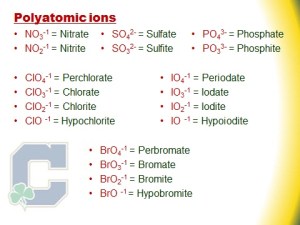
The trick is that you need to know the names of the polyatomic Ions. Here is the first group of them (figure on the right). Here are the rules for naming polyatomic ions:
The entire molecule, NO3 for example, has a charge of -1. So lets say I was joining Nitrate (which is NO3) with Magnesium…
Well, Magnesium’s charge is 2+ so how many Nitrate Ion’s would I need? If each NO3 has a charge of -1 then I need 2! So The formula would be…
The parentheses go around the entire polyatomic ion because the entire ion has a charge and therefore I need 2 of the whole thing.
So, to name the formula, I just use the names of each part: Magnesium Nitrate!
All the same rules for Ionic compounds still apply (Charges must balance & Metals with multiple charges get roman numerals). Try the first set of polyatomic Ion problems (Practice #1) and then move on to the 2nd group of Polyatomic ions, shown at the bottom, and then try their practice problems (Practice #2).

Step 1: iOS 7 – Bring up the toolbar from the bottom of your screen and TURN ON your DO NOT DISTURB Button
iOS 6 – Go to your settings and TURN OFF notifications or TURN ON do not disturb.
Step 2: If there are people sitting behind you facing you, set your flat on your table; otherwise set your iPad up so that it faces you. Make sure your screen is bright enough to see from this angle.
Step 3: Click the link below and begin your Fall 2013 Common Assessment
Step 4: Please fill out honest the Student Feedback Form so that I can improve my teaching (or keep doing what I’m doing)
Step 5: Work on something Academic for the remainder of the time alotted.
Biology: Follow these directions to help better prepare you for your test, which is scheduled for October 4th (Next Friday!)
Tomorrow, I’ll show you how to check your responses so we can make sure everyone completed their assignment. Good luck making your quiz and email me if you have any questions. Have a great Wednesday!
Chemistry: Complete the Ch. 25 discovery questions (available as a PDF on the Chem page) using the iBook. Feel free to work with a partner.
 MrKubuske.com