Honors Biology Final Exams: Semester 2 – 2014

I have had an absolutely blast working with each and every one of you. And it has been my absolute pleasure to get to know you. But, all good things must come to an end, and your end to this class is only a few clicks away.

Before you begin, please close all links and tabs. Then, open the link below and complete the Google Form as your answer sheet. please do not write on the paper version of t he test (use scratch paper provided is necessary). You must complete each page before you can move on to the next, but you can go back and check answers before you submit. DO NOT, under any circumstances hit the “back” button at the top of the page. This will reset your test and cause you to have to re-do the whole thing!

Good luck!

Honors Biology: Semester 2 Final Exam

ECA Reminders

Biology students, here are a couple of reminders before we head into tomorrow’s ECA test.

1. Charge your iPad tonight!

Kind of a big deal since you will be using it for an hour straight tomorrow morning on a standardized test. And don’t assume there will be an available outlet in the room you are testing in. That being said…

2. Bring A Charger

…just in case.

3. Close all Apps and Tabs

Tonight go through and save any process or bookmark any websites that you need to keep. Tomorrow your iPad will need to be a clean slate.

4. Room Assignments

  • 1st period ⇒ 4309 (our regular room)
  • 3rd period ⇒ 4336 (history hallway)
  • 7th period ⇒ 4340 (history hallway)
  • 9th period ⇒ 4338 (history hallway)

5. Vocab Vocab Vocab

When writing your short answer questions, try to use vocab whenever possible. Instead of saying “Aa”, write heterozygous dominant

6. Take your time

You have 55 minutes. Think through an answer before you start typing, or eliminate options you know can’t be right before you choose the best possible answer.

7. Good Luck

Cellular Respiration

Cellular Respiration, although the inputs and outputs seem easy, the process is very convoluted and complicated. Lucky for you, we’re going to simplify it to a point that is appropriate for a High School Biology student.

Keep in mind that Photosynthesis & Cellular Respiration are reciprocal reactions. What that means is that the requirements of Cellular Respiration are the products of Photosynthesis! Likewise, the products of Cellular Respiration are the requirements of Photosynthesis! Its a 3 Billion year long symbiotic relationship! (And you thought your month-long high school girlfriend was a long-term commitment!)

Here is the jist of what Aerobic (meaning with Oxygen present) Respiration entails…


Aerobic Respiartion

Glycolysis

  • Uses 2 ATP to break down Glucose
  • NADH & 4ATP (net gain +2 ATP) are created.
  • The NADH goes to the Krebs Cycle.

Krebs Cycle

  • Uses Oxygen and Acetyl-CoA
  • Makes 2 ATP, NADH, & FADH2 (both of which are electron carriers)
  • Carbon Dioxide is given off as a byproduct.
  • The NADH goes on to the ETC

Electron Transport Chain

  • Uses Oxygen and NADH
  • Make 32 ATP and Water (used as an electron acceptor)


Photosynthesis

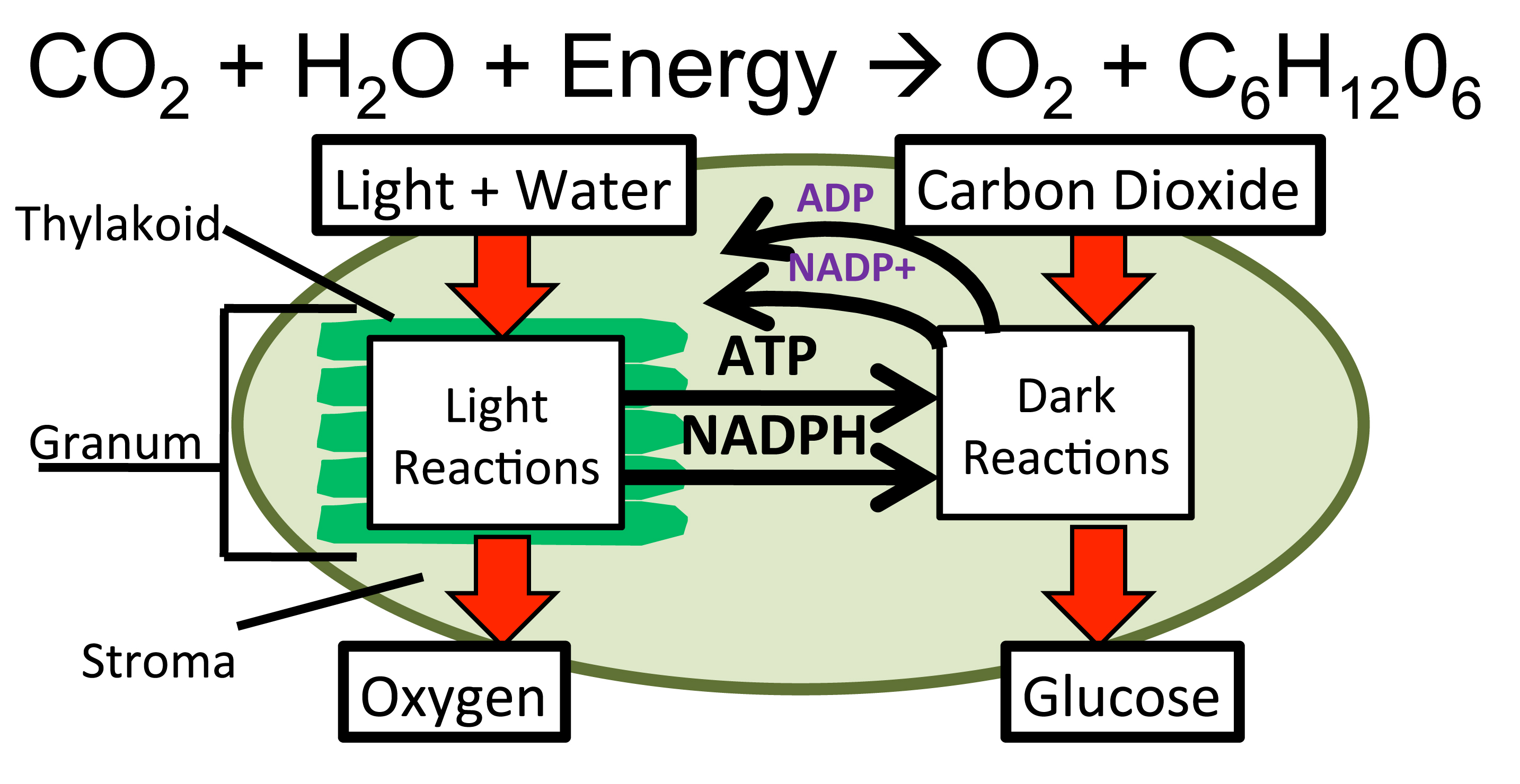
Photosynthesis may seem like an easy topic, based on what you learned in middle school. But, as we go a little deeper into the processes of how Plants chemically create glucose from a gas, a liquid, and sunlight we find that it is a whole lot more interesting and complicated. Below is a graphic organizer to show the parts of the chloroplast, the reactants, the products, and the important molecules involved in both the Light & Dark Reactions.
Photosynthesis14

Light Reaction

  • Light & Water enter the Thylakoid (or granum)
  • Oxygen is released as a byproduct
  • In the process, NADPH and ATP are charged and carry energy to the Dark Reactions.

Dark Reactions

  • The ATP and NADPH, combined with Carbon Dioxide, create Glucose.
  • The leftover NADP+ and ADP go back to the light reaction.

Ecology Unit Review

Today is our last class before our Ecology Unit Test. There will be multiple choice, matching, and short answer questions on the test. I posted a study guide (Key) that we will have time to work on in class.
Below are photos from our most recent notes on succession to help you as you review key questions and vocal. Click on one of the images to enlarge the picture.
IMG_2768 IMG_2769

Here is the YouTube video of the notes for your use as well:

My suggestion is to break this large unit into the 6 sections we discussed:

  1. What is Ecology?
  2. Interdependence
  3. Human Impacts
  4. Cycles
  5. Energy Flow
  6. Changes in Environments

Then, pull the Key Questions from each section (these are the headings during our notes!) If you can successfully and thoroughly answer the Key Question, you have all the information you need to be successful!

This will be our last test in Biology (other than the ECA & the Final)! So Good Luck!


Thursday 4/24

You’re reaction when you see Mr. Kubuske is not here today.

I’m really sorry for having to be out again. I had a feeling I might have to be, which is one of the reasons I pushed the Bio test back to Monday ad allowing retakes on Monday in Chem. You’ve got a fairly straight-forward day ahead of you however. Here’s what I need you to get accomplished today.

Biology

  1. Email or Turn in your Energy in Food lab.
  2. Do the “Energy Transfer” review worksheet you received on monday. You can get the PDF version from the documents page as well. Turn it in when complete.
  3. Use the PPT of the Succession Notes (The video I made would not load properly to YouTube) and make drawings for Primary Succession & Secondary Succession. Be sure to write down key terms and a brief description of Eutrophication.
  4. Do the questions attached to the notes.

Would this abandoned amusement park be considered Succession? Would it be primary or Secondary?

Chemistry

  1. If you are ready to take the test, ask the Sub for a copy of the test and a formula sheet. You may NOT use your iPad, even as a calculator. There are calculators at your table and in the back of the room.
  2. If you are not taking the test today, make sure you have completed all of the 10 steps by tonight because YOU WILL be taking the test tomorrow (you may retake it on Monday if needed).

Flipping The Classroom

Biology, here’s what we’ve got going today. We’re going to flip the classroom… sort of. In a true flipped classroom, I’d send you home with the assignment of taking notes so we could discuss the topics brought up in class the next day. BUT, we’re going to tweak that idea just a little bit. Here’s what I’d like you to do…

  1. Normally, I would give you a list of questions and ask you to answer them to show what you know. To Flip-It, with your table create a list of questions (at least 3 per person) you would like to have the teacher answer for you to gain a better understanding of the topics we’ve covered (Organization, Relationships, Human Impacts, & Cycles). I’ll be around to answer your questions and confirm your readiness to move on (you’ll have to take a quiz to prove you’re ready to proceed).
  2. Take notes on “Energy Flow” (YouTube & PPT slides are available). Here is the PDF if you prefer notes on notability. If you’re going to do paper notes, you’ll need a blank sheet of computer paper folded twice to make three sections.
  3. Then complete the review activity & turn in any outstanding activities from last week. (Biome Books, Review Worksheets, Predator-Prey Lab, & Case Study Questions)

Wednesday 4/16

Students, I hate to tell you bit I have to be out one more day to comfort my family and make my way back to Indiana.

In the mean time, I need you to take notes to answer these three questions for Biology:

  1. What impacts do human’s have on their environment?
  2. What causes ‘climate change’?
  3. What is an ‘invasive species’ and how is it harmful to an ecosystem?

Use the PPT provided, use your eBook, and/or watch the YouTube video on the topic to answer these questions. Tomorrow we’ll be playing a game related to the topic of Human Impacts on ecosystems and you’ll need these notes done to participate.

When you have the notes completed use the notes and pages 314-323 in your ebook to answer questions about 4 ‘case studies’ which can be used to show the principles of ecology. Your job will be to use the information on these pages to answer questions about each case study from the pdf below. The 4th case study, about invasive species, is found in the second pdf below.

Please have these questions completed for class tomorrow.

Chemistry, please continue to work on Gas Law calculations and email me as you complete tasks.