Osmosis in the Kitchen (Lab)

Over the last few classes we’ve been discussing Passive transport, or the movement of materials from high concentration to low concentration without the use of energy. There are three types of Passive Transport, all of which are related:

passive_transport1318873655971

  1. Diffusion: Movement of ANY material from High to Low concentration
  2. Facilitated Diffusion: Diffusion of large materials that requires a transport protein to move across a membrane.
  3. Osmosis: Diffusion of water across a membrane. In your cells, osmosis is a type of facilitated diffusion because it requires Aquaporins to move the water across the cell membrane.

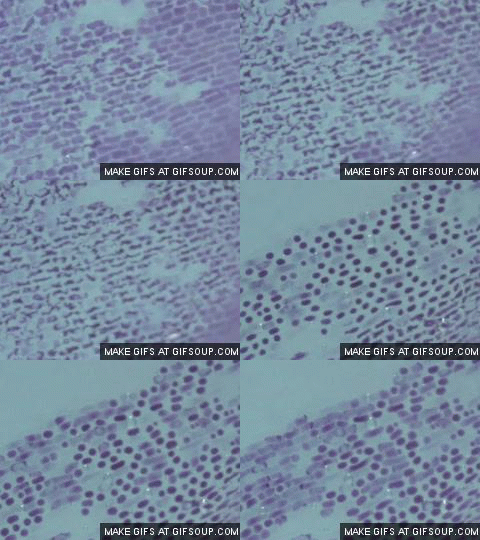
Today in class we’ll be watching Osmosis actually happen with the help of the skin of some Red Onions. As you can see in the GIF, Red onion skin cell’s have a large central vacuole that contains purple pigments. In Isotonic environments, meaning there are equal amounts of water inside and outside the cell, the central vacuole stretches through the whole cell touching the cell walls. But! When the cells are doused with salt water…
onion-cell-plasmolysis-o

The central vacuole’s water goes rushing out because it is now in a Hypertonic environment. This means that there is now more water inside the cell than outside the cell, and since water naturally moves from high concentrations to low concentrations, the water moves out of the cell and causes the central vacuole’s to shrink, as you see in the GIF (and in the lab). But now, how do we bring them back to their normal size?

Since there is now little water left in the cell if we place it in a Hypotonic environment, meaning there is more water Outside the cell than inside, the water will come rushing back in and fill the central vacuoles once again. Amazing.

Common Assessment #1

Step 1: iOS 7 – Bring up the toolbar from the bottom of your screen and TURN ON your DO NOT DISTURB Button

iOS 6 – Go to your settings and TURN OFF notifications or TURN ON do not disturb.

Step 2: If there are people sitting behind you facing you, set your flat on your table; otherwise set your iPad up so that it faces you. Make sure your screen is bright enough to see from this angle.

Step 3: Click the link below and begin your Fall 2013 Common Assessment

Fall 2013 Common Assessment – Google Form

Step 4: Please fill out honest the Student Feedback Form so that I can improve my teaching (or keep doing what I’m doing)

Student Feedback Form: Quarter 1 – Google Form

Step 5: Work on something Academic for the remainder of the time alotted.

Unit 3 Post-Test: So what do you know NOW?

Click the link below to be swept back in time to the day you took the Unit 3 PreTest. I’d like you to retake the quiz and see how far you’ve come and what you have learned:

Unit 3: What do you think you already know

Reminders: Your Biology – Unit 3 Test is tomorrow! It will cover the following topics:

  • Cell Theory
  • Scientists who contributed
  • Types of cells (compare/contrast)
  • Cell Parts
  • Protein creation

Later today I’ll begin to post the projects you’ve created to YouTube and to this site. Feel free to come back and see what a great job you did.

Class Agenda for 9/25

Biology: Follow these directions to help better prepare you for your test, which is scheduled for October 4th (Next Friday!)

  1. Complete your cell coloring
  2. Do the cell crossword puzzles (Label the parts as you fill in the crossword)
  3. Follow the directions listed below to create your own review quiz!
    1. Go to drive.google.com
    2. at the very bottom of the page, click the link that says ‘desktop’
    3. if the page appears with a warning, click ‘continue to desktop version’
    4. to the left of the new page, click the red box that says ‘create’ and then click ‘form’ on the drop down menu
    5. It will then open a new page with a pop up box
      1. Title: Your Name Cell Review
      2. Choose a skin
      3. press ‘ok’
    6. For your first question, put “Name:” in the question title. Then change the question type to ‘text’. Click ‘required question’  and then press ‘done’.
    7. Now press ‘add item’ and start writing your 1st of 10 questions. You can choose to make the question multiple choice, a list, text, or a paragraph. When your first question is finished, press ‘done’.
    8. To add your next questions press ‘add item’ and repeat #6.
    9. Once you’ve made your 10th question click ‘View Live Form’ in the bar near the top. This will allow you to preview your quiz and see how others will view it. If it is ready to publish, click the bar at the top that says ‘drive.google.com’ and it will change to the link for your specific quiz. Copy the entire link.
    10. Now, at the bottom of this post you’ll see a link that says ‘# comments’, click that link
    11. When the comment box appears, paste your link. Below that put your school email address in the email box, and your name – period in the name box.
    12. Finally, once you have posted your quiz, complete 3 quizzes from other students in the same period as you. Feel free to complete more than the three or complete quizzes from other classes too.

Tomorrow, I’ll show you how to check your responses so we can make sure everyone completed their assignment. Good luck making your quiz and email me if you have any questions. Have a great Wednesday!

Chemistry: Complete the Ch. 25 discovery questions (available as a PDF on the Chem page) using the iBook. Feel free to work with a partner.

Origin of Eukaryotes

3pxff (1)

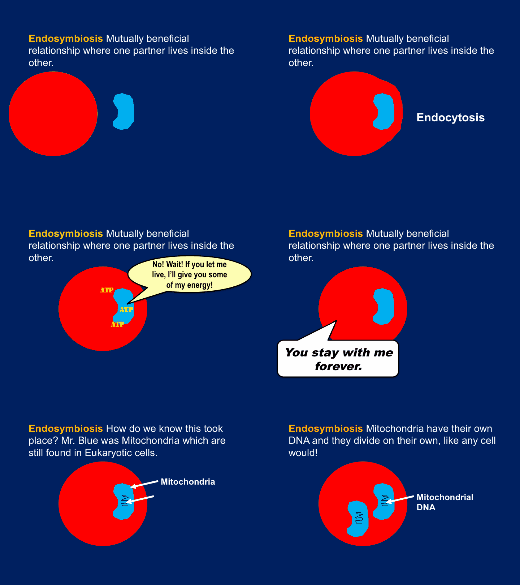
Yesterday we discussed prokaryotes; their characteristics and examples. Today, we’ll examine the eukaryotic cell and its characteristics. But, before we do, lets take a moment to theorize where Eukaryotes evolved from 1.5 billion years ago.

For today’s warm up, do the “Endosymbiosis” worksheet (pg.41 in yesterday’s packet)

Key ← Use it as a resource, not to copy

Then we’ll be taking some time to learn the parts of a Eukaryotic cell. For those of you in 9th period, I’m sorry that I cannot be there to help guide you. But please watch the YouTube Video or open the PPT in Keynote to complete the “Cell Part Chart” in a paper format or as a PDF.

On Monday, we’ll review the types of cells as well as this chart and the parts of a Eukaryotic cell. Then on Tuesday, we’ll look at some real-life eukaryotes under the microscope. Have a great last weekend of summer!

Test(s) Monday!

Honors Biology and Academic Chemistry…

Both classes have their Unit 2 test on Monday. I would really rather not do a test right after a weekend, but if you have concerns or questions please ask me on Friday! (remember tomorrow is our Day of Service and Friday’s classes are shortened for Counties and Mass)

The study guides are posted, and I will post answer keys to them this weekend.

Biology… pay special attention to the Vocab List.

Chemistry… pay special attention to the calculations (# of atoms, molar mass, % comp, and energy transfer).  Go back through my older posts (Like this one)for review.