Enzyme Notes

So as a review, Enzymes are biological catalysts that lower the amount of Activation energy needed to carry out a chemical reaction. They are usually named for the molecule they breakdown or build-up (Lactase → Lactose). If they are placed in solutions with harsh temperatures or pH, they will Denature (change shape) and chemical reactions can no longer take place. For more information, check the infographic below or watch the YouTube Video

Slide15

This week in…

Lots of great stuff happening this week in Science and at Cathedral High School. Here’s a recap..

Biology:

Students are practicing using the Scientific Method by devising experiments to test the strength of toilet paper -or- the absorbency of paper towels, they’ve come up with some pretty creative ideas.
image
We’ll also start covering what it means to be “Alive” this week and will soon be moving on to Unit 2… Biochem!

SEHS:

We’re working on 6.4 on our websites which is all about good training regimens and the principles that dictate what a good training program is.

Meet The Teacher Night!

We’ll be welcoming our students’ parents into our classrooms this Thursday so they can meet the teachers and see what their student is in for this school year!

Beat Ben Davis!

Our fall sports are off and running with Soccer and Tennis already starting matches. Volleyball kicks off this week as well as our Cathedral Fighting Irish Football team who looks to topple nationally ranked Ben Davis on Friday night!


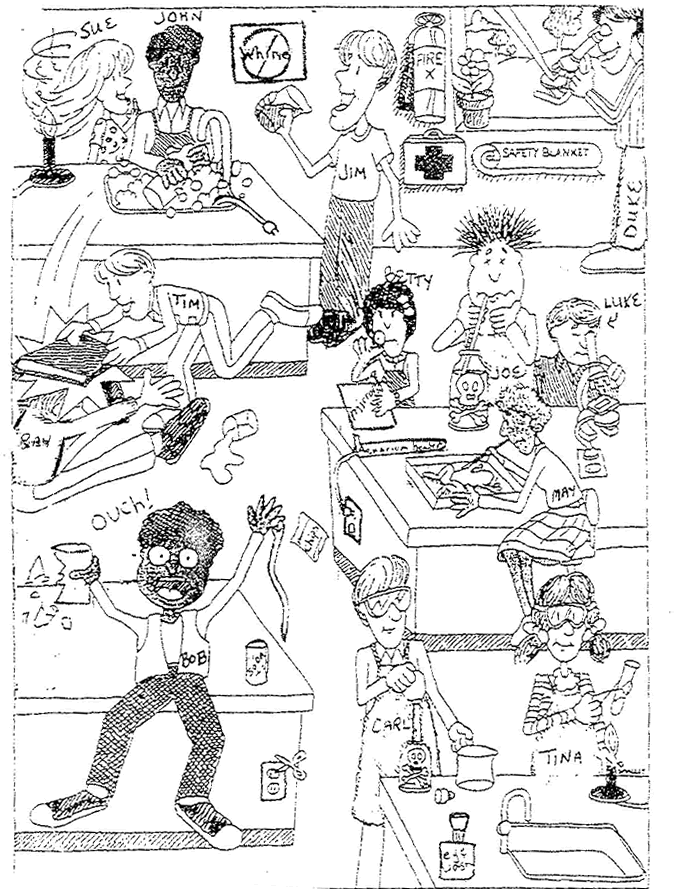
Lab Safety… it’s no Accident

Today we’ll be going over some important information about your safety in a Lab setting. After review the Lab Safety rules (check the documents page for your specific class for a PDF version), take a look at the image below. See if you can spot some incidences of failing to follow lab procedures for safety.

Reminder there will be a “Common Sense” Lab Safety Quiz tomorrow and you must pass with 100% before being allowed to use the lab.

Also! You must have a signed Lab Safety Contract turned into Mr. Kubuske by Wednesday to be allowed to use the lab.

First Day of School 2014!!!

I know… I feel the same way.

Welcome to Mr. Kubuske’s Class Blog. First, please set a bookmark or a link to your home screen. After that feel free to browse this page. At the top are links to class pages where notes, assignments, and documents will be posted for you to download as we work through our curriculum. There’s a page for students, a page about Mr. K, and other resources available. On the right (or bottom if you are using Safari on the iPad) are links to my twitter and other information that will help you.

Next, there are 3 papers on the front table I’d like you to pick up. You will need to keep these papers all semester so put them in a safe place. Eventually, these papers will need to go in your Class 3-ring binder.

Last, for today’s class activity, you’ll need to get a piece of string. The strings are on the old pencil sharpener near the bookcase. Please go ahead and pick up a piece of string and come back to your seat. Once you have the papers and your string you can complete the assignment titled “Biology Procedures Activity” that the instructor gave you.

As a reminder, you will need to download your iBook at home or in a place where you can be on a wifi network for a long period of time.

Thanks for participating and we look forward to working with you this year!

ECA Reminders

Biology students, here are a couple of reminders before we head into tomorrow’s ECA test.

1. Charge your iPad tonight!

Kind of a big deal since you will be using it for an hour straight tomorrow morning on a standardized test. And don’t assume there will be an available outlet in the room you are testing in. That being said…

2. Bring A Charger

…just in case.

3. Close all Apps and Tabs

Tonight go through and save any process or bookmark any websites that you need to keep. Tomorrow your iPad will need to be a clean slate.

4. Room Assignments

  • 1st period ⇒ 4309 (our regular room)
  • 3rd period ⇒ 4336 (history hallway)
  • 7th period ⇒ 4340 (history hallway)
  • 9th period ⇒ 4338 (history hallway)

5. Vocab Vocab Vocab

When writing your short answer questions, try to use vocab whenever possible. Instead of saying “Aa”, write heterozygous dominant

6. Take your time

You have 55 minutes. Think through an answer before you start typing, or eliminate options you know can’t be right before you choose the best possible answer.

7. Good Luck

Evolution Projects

Check out some of the amazing work our Honors Biology students created to share with some local middle school students to help them learn the basics of Evolution:


Some of the students created twitter accounts for middle schoolers to follow and included key concepts as well as #hashtagvocab


Before we depart…

You on spring break…

I know you are anxious to get out of the building and spend a week away having fun on spring break. Before you go though, I have a couple of questions about how you want to spend the next 3 weeks studying Ecology. Do me a favor and read the questionnaire below and answer the questions fully and honestly. After that, have a great break…

P.S. – We can’t wait to see your evolution projects on April 7th!

What did a T-Rex Taste Like?

trexWhat did a T-Rex Taste Like?

Believe it or not, we actually have was of finding this answer despite the fact the Tyrannosaurus Rex has been extinct for over 65 million years. We can determine a T-Rex features, including taste, using similar features (which we now know are called homologous structures). shared with animals the T-Rex is closely related to.

Recall that yesterday we learned that the more features you have in common, the higher the probability that you share a common ancestor/DNA (the exception would be convergent evolution where two species become increasingly similar despite the fact the originated from different ancestors). So what we can do is plot relatedness, based on characteristics, on a graphic called a cladogram, like the one shown here.

So Today, that’s exactly what we’ll be doing, using the link at the top of this post, you’ll follow the steps to learn how cladograms are created, organized, and what the different branches of it mean. By the time you are through, you will know what it tastes like to bite into a big fat dino-burger!