Evidence of Evolution

Evidence of Evolution PDF

The images below show different types of evidence that prove Natural Selection is the driving force behind evolution. Use these images, information rom your iBook, and the web to create answers to my questions and learn more about the evidence of Natural Selection. For an added challenge, see if you can match the name of the evidence to it’s illustration (Mouse over the images to see the answer):

Analogous Structure, Homologous Structure, Vestigial Structure, Embryology, Amino Acid  (DNA) Sequence, Divergent Evolution, Convergent Evolution, Coevolution, Gradualism, Punctuated Equilibrium, Artificial Selection, Sexual Selection, Founder Effect, Directional Selection, Disruptive Selection, Stabilizing Selection

22_17HomologousForelimbs-L

Why do all of these DIFFERENT animals have the SAME bones?

aasequence_primates

Who do we SHARE the most DNA with? What does this mean about our Evolution?

analogous

Why do these DIFFERENT types of animals have the SAME feature? Does this mean that they are closely related? or does it mean that the trait they share is an advantage in their environment?

artificial

If Humans choose the traits they want plants or animals to have is it still natural selection?

convergent-evolution-marine-all-about-reptiles-com

Why do these DIFFERENT types of animals look so SIMILAR? Does this mean they are closely related? What do Analogous structures have to do with this type of evolution?
divergent_generic

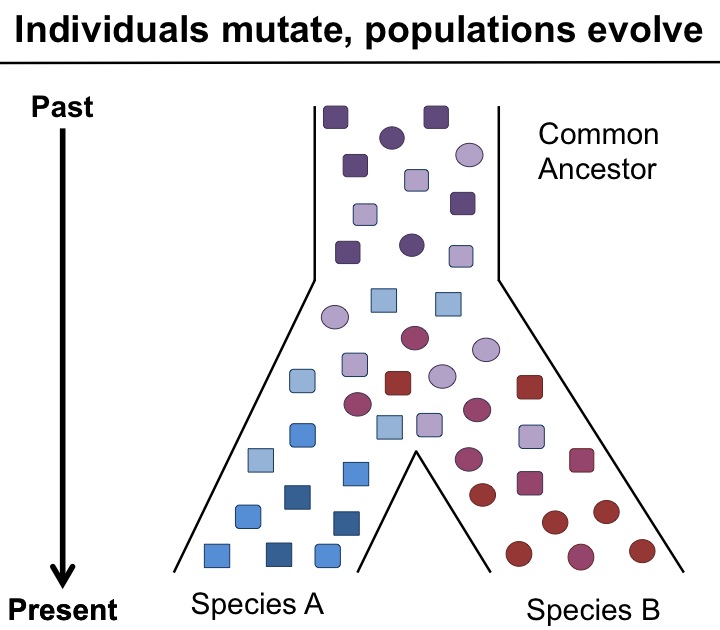
So there was a large population with many variations… but they separated from one another over time…

divergent

Are these 2 new species of butterflies or still the same? What will happen over millions of years, will they look more similar or more different?
founder

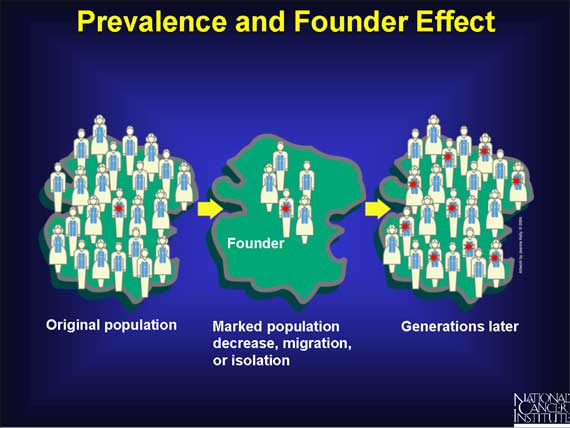
How come only one individual had a red star in the original population, but almost half have one in the new/resulting population?

gene_conservation_med

Why do humans share more DNA with Mice than chickens? What does this tell us about our evolution?

whale-vestigial-structure

Whales have legs??? What does this information tell you about Whale ancestors? where did they live? What has happened to the legs over millions of years and why did this happen? Can you think of any human examples of this?
types of selection

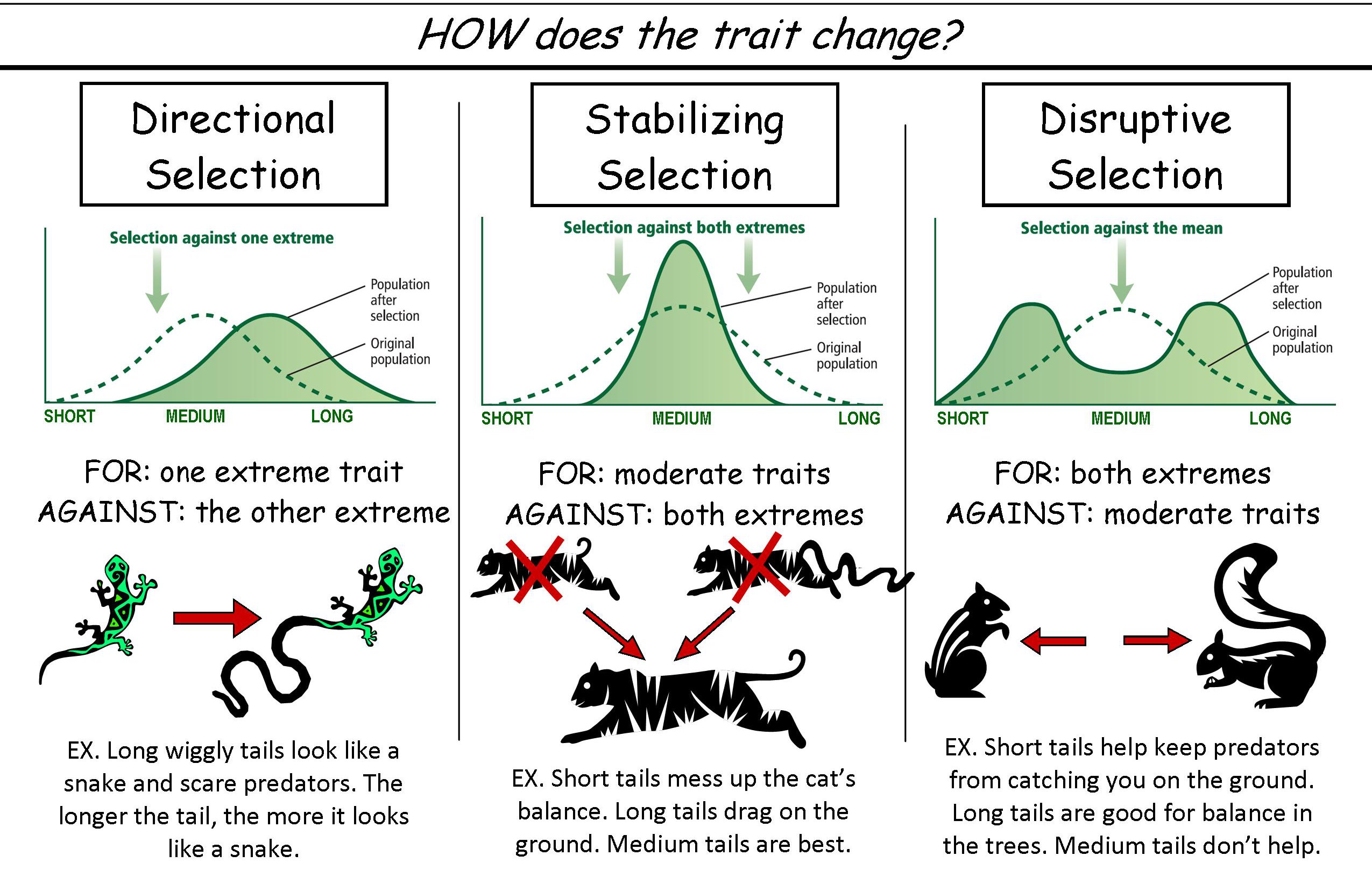
Directional means the POPULATION mean will move toward one extreme.
Stabilizing means the POPULATION mean will move more toward the average.
Disruptive means the POPULATION will have two extremes that have large groups and less in the average. What will happen to this population over time?

vertebrate-embryos

Why do human embryos look so similar to fish embryos??? Does this mean we’re related to fish?

peacock_display

does this display help the peacock survive in its environment? or is it just for the ladies?

puncgrad

Compare the two types of evolution… Which one says that catastrophic events cause major changes in the population? How would you describe the other?

hummingbird

Do you think this plant always had flowers perfectly suited to a hummingbird’s beak?

The Fossil Record

One of the most enjoyable parts for both myself and my students about studying evolution, is a chance to search for evidence and create your own hypotheses and theories based on your own evidence. Sure the terms and concepts may not be up for debate, but how we use and interpret them is. Today, you and your new table mates will seek to answer a series of questions. Each of these questions will lead you to creating your own theory which you will type in below.

The Guiding Questions can be found by following the link to the Google Doc. Make sure, you follow the directions carefully to make your own version of the Google Doc.

The Fossil Record: Guiding Questions

You will use the iBook and an interactive website from the University of California Berkley to answer the questions.

UCMP: Getting Into the Fossil Record

Finally, when you are done with your guiding questions as a group, you will formulate your own theory and share it with the world. Answer the question below and feel free to view how other interpret the data.

Class Results/ Theories 

Common Assessment #3

Common Assessment #3 – Link

Tomorrow we’ll be taking the 35 Question Common Assessment for the third quarter. It will cover Unit 7 (Reproduction) & Unit 8 (Genetics). The study guide is available on the Semester 2 Documents page, or you can get it from the link below. The key is also available for viewing this afternoon.

Common Assessment #3 Study Guide

Here are the list of key terms we’ve covered during the Second Semester. Click to enlarge:IMG_2449

Below is all of the videos from Unit 7 linked together as a playlist. If you would rather watch one section at a time individually, the links are still available on the Semester 2 documents page or on my YouTube Page

Here are the videos from Unit 8: Genetics

The Unit 7 Hunger Games

Today in #hbio we’ll be reviewing for tomorrow’s test over Unit 7. To review, you’ve been selected to be Tributes in the Unit 7 Hunger Games!!! Ok, so its not life or death survival of the fittest, instead we’ll be doing a speed stations activity. There are 32 stations posted throughout the room. You and a partner will try to complete these stations as ACCURATELY & QUICKLY as possible. You are Competing against the other players in your class. The fastest, and the most accurate, will receive a bonus point.

At the end of the day, I will post the stations on this site for you to review with. Be sure to study your Unit 7 Study Guide as well. Good Luck, and may the odds be forever in your favor…

Unit 7 Review: Answer Sheet – Link –

Mitosis Vs. Meiosis

“So what’s different about Mitosis versus Meiosis?”

 Well looking at the picture we see Mitosis on the left… There is a single cell, which duplicates its chromosomes, divides, and the result are two cells identical to the parent cell.

Meiosis, on the right, all those same steps occur… BUT THEN! Another cell division occurs! We do PMAT a second Time (Thats Cray-Cray Mr. K)! The result then are 4 cells, with half the number of chromosomes, and each one has a unique set of chromosomes.

I know what you’re thinking… “But why would we only need half the number of chromosomes? Doesn’t each one of the cells of our body need all 46 chromosomes!?”

It is true that each one of our Somatic, or Body, cells needs a complete set of chromosomes. But our Gametes, or Sex Cells, only need half the number of chromosomes. This is known as being Haploid, or having one set of chromosomes. And I bet you already know why! That’s right, the other half comes from the 2nd parent during sexual reproduction (That’s off the chain Mr. K). When the male and female gametes meet (Fertilization), they combine to form one new cell called a Zygote that has two sets of chromosomes, one from Mom and one from Dad. This is known as being Diploid.

The Red X and the Blue X are duplicated chromosomes. During Prophase 1, they sometimes “Switch Legs”. This is known as Crossing Over.

The coolest part about the whole process is that it makes you Unique. And not in the Sesame Street, “You are special,” kind of way. More like, there are more than 8 million different genetic combinations that you can create in each of your gametes and they are assorted completely randomly (Independent Assortment), meaning that for each of your 23 pairs, you can give either one of the chromosomes, its not predetermined! And sometimes, Duplicated Chromosomes will even switch pieces (Crossing Over) making them even more unique!

All in all, Meiosis is a pretty unique process and I hope you enjoy learing about it as much as I enjoy teaching it!

The DNA Puzzle

Today we’ll begin our long journey through the wide world of DNA. As we begin to look forward to a fun filled few weeks, its at this point that we look back into the past and discuss the important people who’s contributions and life’s work answered some of life’s biggest questions. Below are links to videos that are taken from the website DNAi.org (provided you are using a computer with flash and not an iPad). Use them to complete the introduction to these scientists as a part of this webquest (PDF)

Together the contributions come together to fit like pieces of a puzzle (Read Here) and the shape of the DNA molecule was finally uncovered.

Common Assessment #1

Step 1: iOS 7 – Bring up the toolbar from the bottom of your screen and TURN ON your DO NOT DISTURB Button

iOS 6 – Go to your settings and TURN OFF notifications or TURN ON do not disturb.

Step 2: If there are people sitting behind you facing you, set your flat on your table; otherwise set your iPad up so that it faces you. Make sure your screen is bright enough to see from this angle.

Step 3: Click the link below and begin your Fall 2013 Common Assessment

Fall 2013 Common Assessment – Google Form

Step 4: Please fill out honest the Student Feedback Form so that I can improve my teaching (or keep doing what I’m doing)

Student Feedback Form: Quarter 1 – Google Form

Step 5: Work on something Academic for the remainder of the time alotted.