The Unit 7 Hunger Games

Today in #hbio we’ll be reviewing for tomorrow’s test over Unit 7. To review, you’ve been selected to be Tributes in the Unit 7 Hunger Games!!! Ok, so its not life or death survival of the fittest, instead we’ll be doing a speed stations activity. There are 32 stations posted throughout the room. You and a partner will try to complete these stations as ACCURATELY & QUICKLY as possible. You are Competing against the other players in your class. The fastest, and the most accurate, will receive a bonus point.

At the end of the day, I will post the stations on this site for you to review with. Be sure to study your Unit 7 Study Guide as well. Good Luck, and may the odds be forever in your favor…

Unit 7 Review: Answer Sheet – Link –

Its the most wonderful time of the year…

Christmas time + Finals Week =

Here is the Biology Study Guide Key . Below is all of the YouTube videos from this semester as a playlist. You can skip past the stuff you’re good on and go on to the next. Good luck!

Making Monsters

Thats right, today in class we will be making monsters based on their DNA code.
First make sure you get BOTH hand outs from the table up front. Then follow the directions on the front page to draw the Monsters on the back page. Here’s what you do:

  1. Use the DNA code to match the mRNA compliments. (Remember: T→A but A→U)
  2. Use the mRNA to match the tRNA compliments.
    1. You can check your work by comparing the tRNA to the DNA; they should be identical except that the ‘T’s have become ‘U’s.
  3. Use the chart at the bottom of the page to determine what amino acid (#) is coded for by each mRNA Codon. Write the number in the Amino Acid section.
  4. Repeat this process for all mRNA codons.
  5. Use the Amino Acid sequence to determine what trait has been coded for by the DNA.
  6. Once all traits have been decoded, draw your MONSTER! Give him/her a name and add any other traits you want including the ones coded by the DNA. The drawings should be neat and colored.
  7. Finally, write down the FULL sequence of DNA from the original DNA provided, as well as the list of traits.

There You Go! That’s how easy it is to make a monster… sort of. Either way, this is great practice doing transcription and translation which are the two steps of Protein Synthesis. So have fun and I’ll see you again soon!

Traduccion (Translation)

(Bio students: Sorry I can not be there with you today. But no worries, I’ve got an easy “Monday After a Long break” Lesson plan for you. The notes are already done for you. Just read through the information below -OR- watch the youtube video. Feel free to highlight or add notes as you go. Then work on:

I’ll be back tomorrow to explain how we will be making monsters… you heard me. Enjoy your day!)

Translation (or Taduccion in Spanish) is the second phase of Protein Synthesis. Last time, we learned about Transcription and the types of RNA. Today, we’ll learn how to convert the “language” of As, Gs, Cs, & Us to Amino Acids and proteins that your body actually “understands”, or uses.

StartCodon

The ‘Start Codon’, AUG, signals the beginning of Translation and where the Ribosome should start adding tRNAs.

Continue reading

RNA & Transcription

Today in Biology we’ll start our last Unit of the semester… Protein Synthesis. Protein Synthesis is sometimes referred as the “Central Dogma” of Biology, meaning its the key idea. The key idea of protein synthesis is that DNA codes for our traits and that code is used to create proteins that actually are our traits. All other parts of biology either exist because of, or are incorporated with Protein Synthesis.
There are two major parts of protein synthesis:

  1. Transcription: Using DNA → to make RNA
  2. Translation: Using RNA → to make Protein

Today we’ll be focusing on Transcription and the stuff it makes, RNA.

Continue reading

Plan for 11/2

Sorry for not being there today. I am not feeling well and need to take the day to recuperate. In the mean time here is what I want you to work on while I’m out. Its separated by class:


Alpha:

    1. Watch the YouTube video on Active Transport (below) and take notes. If you want to download the notes page and take notes on notability it can be found by clicking this link.

  1. Then download (click here) and answer the review questions with your table mates… or “tates” as I like to call them.

As a reminder… your Unit 4 test is Next Tuesday!

A Period:

    1. Watch the YouTube video on Active Transport (below) and take notes. If you want to download the notes page and take notes on notability it can be found by clicking this link.

  1. Then download and complete the review activities below in Notability. Do this with your table mates… or “tates” as I like to call them, but everyone should complete their own.
    1. Review Questions
    2. Wordsearch
  2. We will go over both in class on Monday

As a reminder… your Unit 4 test is Next Tuesday!

Common Assessment #1

Step 1: iOS 7 – Bring up the toolbar from the bottom of your screen and TURN ON your DO NOT DISTURB Button

iOS 6 – Go to your settings and TURN OFF notifications or TURN ON do not disturb.

Step 2: If there are people sitting behind you facing you, set your iPad flat on your table; otherwise set your iPad up so that it faces you. Make sure your screen is bright enough to see from this angle.

Step 3: Click the link below and begin your Fall 2016 Common Assessment

Fall 2016 Common Assessment – Google Form

Step 4: Please fill out honest the Student Feedback Form so that I can improve my teaching (or keep doing what I’m doing)

Student Feedback Form: Quarter 1 – Google Form

Step 5: Work on something Academic for the remainder of the time allotted.

Organic Compounds & Carbohydrates!

Not quite how I pictured God looking but ok.

Okay, I know it doesn’t necessarily sound exciting… but keep in mind that organic compounds are what you and I and every living thing on the planet are made of! Kind of cool when you think about it… maybe it’s like God’s ingredients for life!

Anyways, today I’m going to introduce you to the idea of what an organic compound is, then we’ll cover the types, and finally spend some time going in depth into one of the most important organic compounds: Carbohydrates!
Carbs are pretty amazing in that its our body’s primary source of good clean energy. You’ll learn a lot more about them when you watch my video below. And speaking of… I would like for you to take notes on these topics using my youtube video which you can find at the bottom of this post. You should get a paper version of the notes or you can download a pdf version for notability by clicking this link. Either way, I hope you have a new appreciation for organic compounds soon! Bon Appetit!

Lab Safety… it’s no Accident

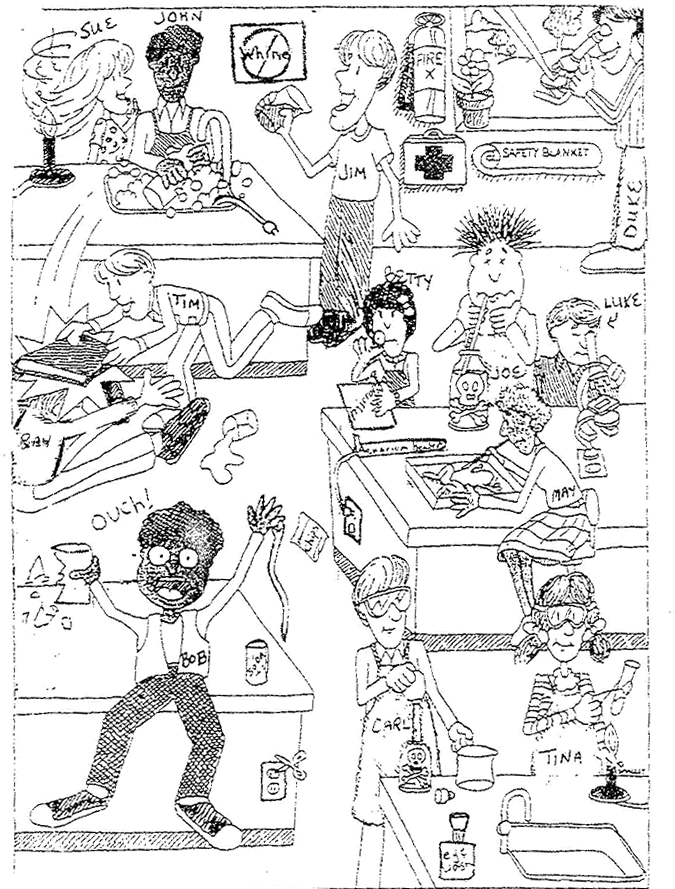
Today we’ll be going over some important information about your safety in a Lab setting. After review the Lab Safety rules (check the documents page for your specific class for a PDF version), take a look at the image below. See if you can spot some incidences of failing to follow lab procedures for safety.

Reminder there will be a “Common Sense” Lab Safety Quiz!

First Day of School (ok, the cycle)!

I know… I feel the same way.

Welcome to Mr. Kubuske’s Class Blog. First, please set a bookmark or a link to your home screen. After that feel free to browse this page. At the top are links to class pages where notes, assignments, and documents will be posted for you to download as we work through our curriculum. There’s a page for students, a page about Mr. K, and other resources available. On the right (or bottom if you are using Safari on the iPad) are links to my twitter and other information that will help you.

Next, there are 3 papers on the front table I’d like you to pick up. You will need to keep these papers all semester so put them in a safe place. Eventually, these papers will need to go in your Class 3-ring binder.

Once you have the papers you can complete the assignment titled “Biology Procedures Activity” that you picked up from the front table.

As a reminder, you will need to download your iBook at home or in a place where you can be on a wifi network for a long period of time.

Thanks for participating and we look forward to working with you this year!